NEW!
Meet Flyntlok at Equip Expo 2026:
August 19, 2026
Equipment dealerships are built on relationships. But for many customers, that relationship now begins well before they call a salesperson or walk through the door.
It may start with a search for a particular machine, an advertisement for a seasonal offer, a visit to an inventory page, or a service request submitted from a phone. Each interaction creates an opportunity, but only if the next step is clear and the dealership is ready to respond.
That is why more website traffic is not always the answer to a dealership’s marketing challenges. If inventory is outdated, an advertisement leads to the wrong page, an inquiry sits in an inbox, or no one can connect a lead to a sale, increasing traffic may simply send more people into a disconnected process.
Before spending more, take 15 minutes to find out where prospective customers may be getting lost.
Download the checklist or get started below!
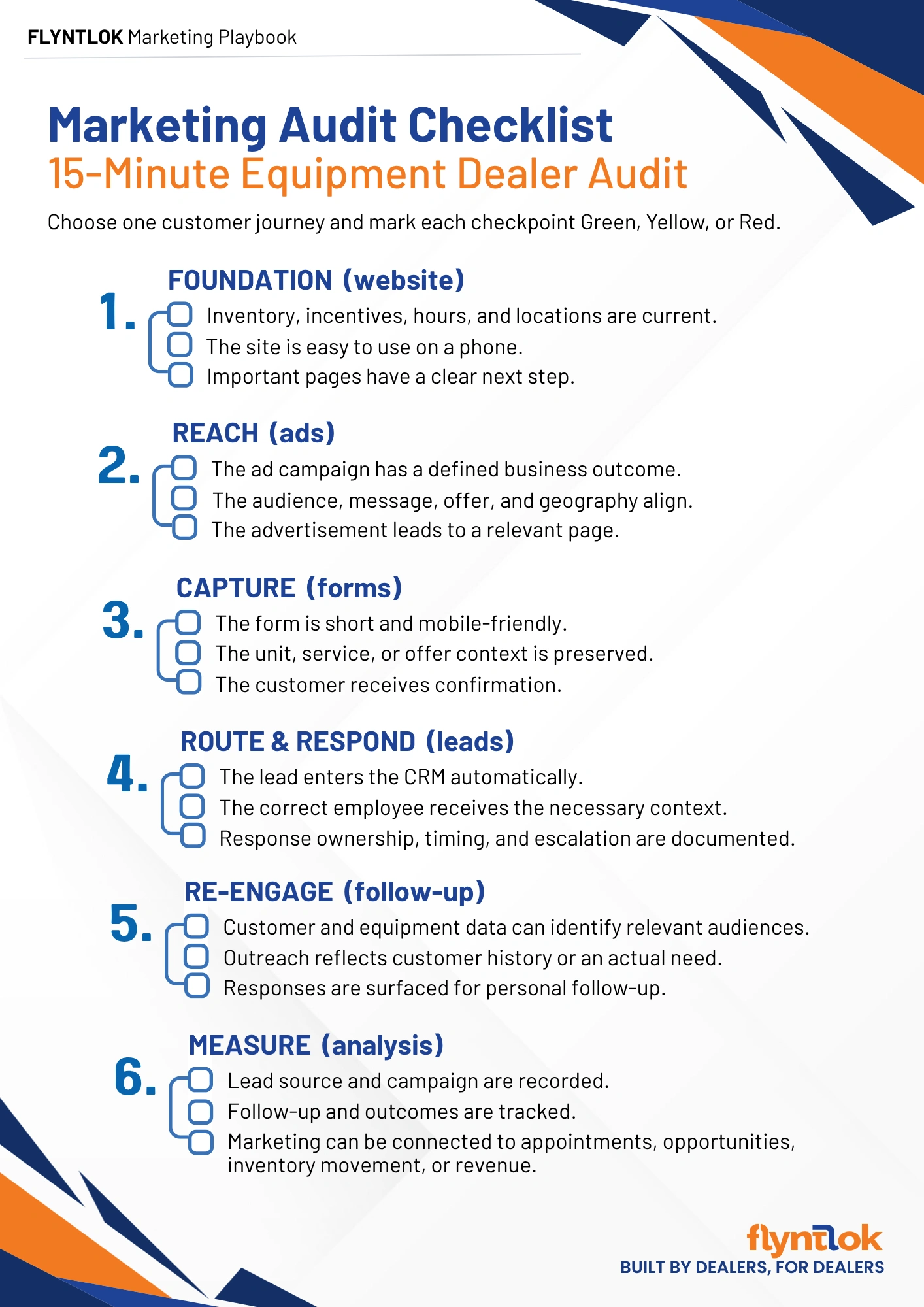
Start With One Customer Journey
Do not try to audit your entire marketing program at once. Choose one business priority and follow one realistic customer journey from beginning to end.
For example:
Open your website on a phone, preferably as a new or private browser session, and experience the process as a customer would. Then evaluate the journey across the following six checkpoints.
Time: Three minutes
For a new buyer, your website may be the dealership’s first visit. Before that customer meets your team, the site is already communicating whether your dealership is credible, current, knowledgeable, and easy to work with.
Try to complete the same task your chosen customer would. Find a specific unit, current incentive, service offering, rental category, location, or phone number.
Ask:
Pay particular attention to inventory and incentives. A buyer who clicks on a unit that sold weeks ago experiences frustration at the exact moment your dealership is trying to establish trust. A scheduled inventory feed can reduce duplicate entry and help keep the website aligned with the units available in your dealership management system.
Watch for: outdated units, expired offers, missing photographs, slow mobile pages, unclear navigation, or important information spread across multiple locations.
Time: Two minutes
High traffic does not automatically mean high opportunity. The goal is to attract people who are likely to need the equipment, service, parts, or rental offering your dealership provides.
Review one current advertising campaign, or sketch out the path for a campaign you plan to launch, and ask:
Start with the business priority, not the marketing channel. “Advertise on Facebook” is a tactic. “Sell three aging compact tractors within 50 miles of our western branch” is an objective that can guide the audience, message, creative, landing page, budget, and measurement plan.
Current inventory can also make advertising more useful. Dynamic inventory advertising uses a scheduled inventory feed to help generate and refresh advertisements for units, models, categories, branches, or seasonal promotions. This reduces manual work and lowers the risk that a customer will click an advertisement for equipment that is no longer available.
Watch for: campaigns without a defined outcome, broad audiences receiving the same message, and advertisements that send every visitor to the homepage.
Time: Two minutes
Once a prospective customer reaches your website, do not make them hunt for a way to continue the conversation.
Every high-intent page should offer a clear next step, such as:
Complete the form yourself. Make note of how many fields it requires, whether it works on a phone, and what happens after you press submit.
A form should collect enough information to understand and route the request without feeling like an application. For many inquiries, a name, contact method, location, and the product or service of interest may be enough to start a conversation.
Watch for: long forms, generic “contact us” buttons, no confirmation that the inquiry was received, or a form that loses the context of the unit, offer, or service the customer was viewing.
Time: Three minutes
This is where some of the most valuable leads quietly disappear.
A customer can respond to an excellent advertisement on a polished website and still receive a poor experience if the inquiry:
Submit a test lead and follow it internally. Determine exactly where it goes, who is notified, what context appears in the CRM, and how the dealership knows whether someone followed up.
Ideally, the Lead should enter the CRM automatically with the customer’s contact information, product or unit viewed, campaign source, location, request type, and submission time. The appropriate salesperson should receive an immediate notification and understand what the customer wants before making contact.
Define a response expectation, too. A strong process should aim to respond within one business hour whenever possible, while clearly documenting ownership and escalation if that does not happen.
Watch for: manual re-entry, inconsistent routing by location, missing campaign or equipment context, undefined response expectations, and no escalation for an unworked inquiry.
Time: Two minutes
Marketing is not only about acquiring new customers. Your dealership may already have years of customer, equipment, purchase, and service history that can identify relevant reasons to reconnect.
Consider whether you can easily find and reach:
The goal is not to send more generic promotions. It is to send a useful message to a customer who has a reason to hear from your dealership.
Flyntlok Smart Campaigns helps employees describe an audience in plain language, use dealership data to build the list, and generate an AI-assisted SMS draft. The employee reviews the audience, edits the message, sends a test, and chooses when to send it. When a customer responds, the dealership’s team can surface the response, create a Lead, and continue the conversation personally.
AI can reduce the manual work involved in finding an audience and drafting outreach. Your employees still control the message and the relationship.
Watch for: valuable customer data that is never activated, one-size-fits-all messaging, and outreach that is disconnected from equipment ownership, service history, or current inventory.
Time: Three minutes
Clicks, impressions, and website traffic can help diagnose performance, but they are not the dealership’s ultimate outcome.
For the customer journey you selected, can you determine:
When the website, advertising, CRM, and follow-up process are connected, marketing and sales can evaluate the same journey. The dealership can see which investments generate meaningful customer interest, where the process needs attention, and which activities should be expanded or changed.
Watch for: reporting that ends at clicks or form submissions, leads with no recorded source, and sales outcomes that cannot be traced back to the activity that created them.
At the end of the audit, give each checkpoint a simple rating:
Do not worry if the audit reveals several gaps. You do not need to rebuild the entire marketing program at once.
Start with the red or yellow issue closest to the customer and the revenue opportunity. If leads are reaching the wrong person or receiving no follow-up, fix that before increasing advertising spend. If the website shows unavailable inventory, correct the data flow before sending more buyers to those pages.
Then choose one measurable improvement, assign an owner, and repeat the audit after the change.
Effective equipment dealer marketing is not a collection of disconnected advertisements, emails, website updates, and sales tasks.
It is a connected journey:
When those steps work together, marketing becomes easier to evaluate, sales teams receive better context, and customers experience less friction. Most importantly, the dealership can turn more interest into stronger relationships and measurable growth.
Ready to find the gaps in your customer journey? Download the checklist. Use this audit to trace one real path through your dealership, from website visit to business result. Then see how Flyntlok can help connect your inventory, CRM, customer data, and follow-up in one dealer management system.
Request a demo if you're ready to learn how Flyntlok can turn your customer data into revenue!




.webp)


