WATCH HERE:
Our Equip Expo AI Session is Now On-Demand!
The Connected Marketing Playbook for Equipment Dealers
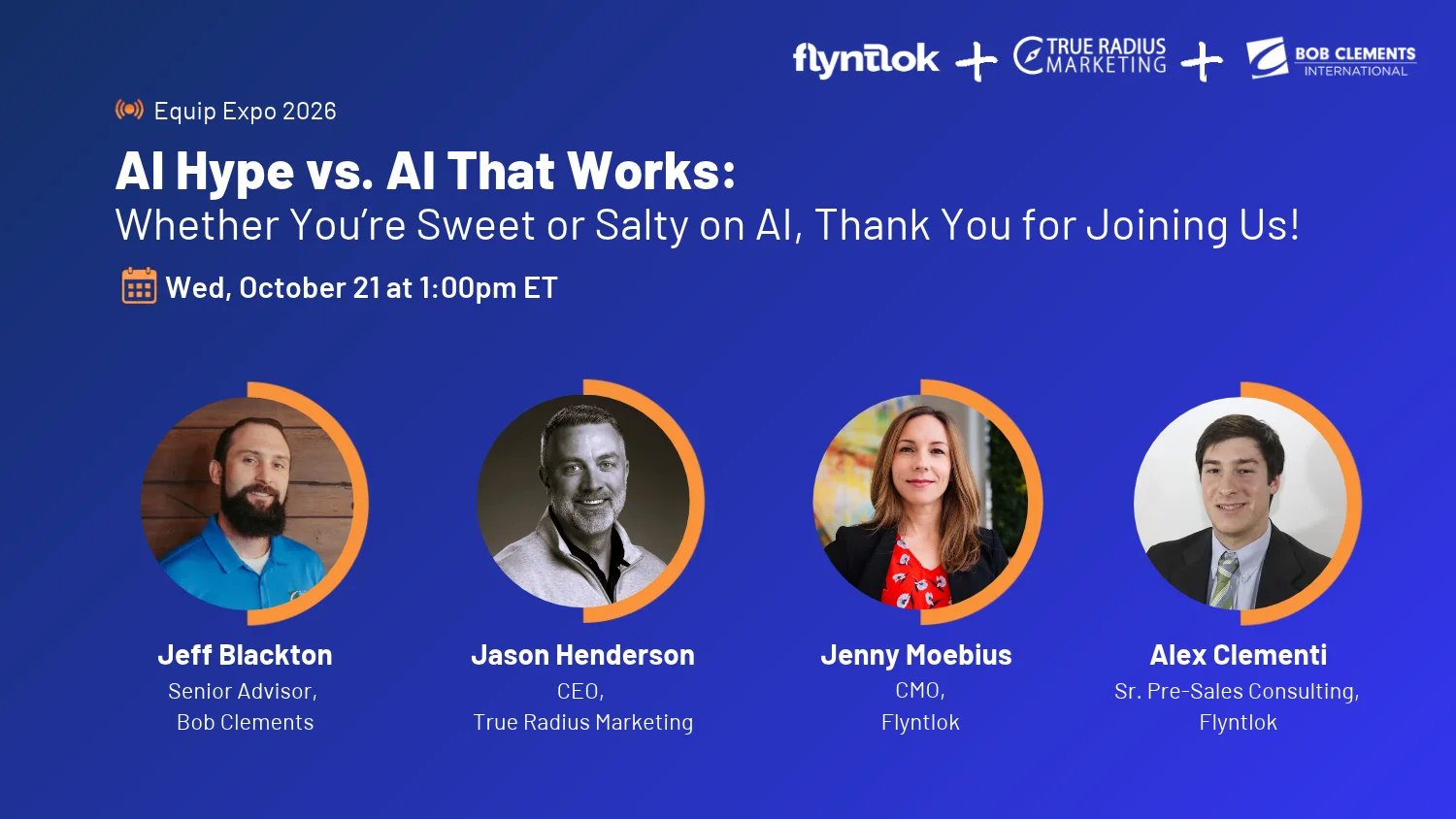
Jenny Moebius of Flyntlok and Jason Henderson of True Radius Marketing show equipment dealers how to connect the website, ads, CRM and customer data so more online interest turns into sales and service revenue.

Fill out the short form and the recording plays right here.
Register once. You get the live link and the recording.
We are live now. Register to jump in.
Check back for the new date, or email marketing@flyntlok.com.
Form not loading? Open the webinar in a new tabEquipment dealerships grow through strong customer relationships, and today many of those relationships start online. When your website, advertising, CRM and customer data run separately, outdated inventory, lost inquiries and slow follow-up cost you real deals.
Flyntlok and True Radius Marketing walk through how to connect the customer journey, from the first website visit through sales follow-up and repeat business, with practical steps to turn marketing activity into qualified opportunities and measurable revenue.


How to Build a Better Dealership Website, Reach the Right Buyers, Convert More Leads, and Turn Customer Relationships Into Revenue
Featuring:
Equipment dealers know how to build relationships. They know their customers, understand their communities, and have spent years developing the expertise and trust that keep people coming back.
But today's customer journey often starts long before someone walks through the dealership door.
Buyers are researching equipment online, comparing brands, checking inventory, looking for manufacturer incentives, and increasingly turning to AI-powered search tools for recommendations.
And while many dealerships are investing in websites, digital advertising, and customer relationship management tools, there's a persistent challenge:
How do you connect those investments to actual customers, sales, and revenue?
In the webinar From Clicks to Customers: The Connected Marketing Playbook for Equipment Dealers, Flyntlok CMO Jenny Moebius and True Radius Marketing CEO Jason Henderson break down how equipment dealerships can build a more connected, effective marketing and sales process.
Drawing on their experience working with outdoor power equipment, agriculture, and other equipment dealerships, Jenny and Jason explore the entire customer journey, from helping prospective buyers discover your business to making sure every inquiry gets the attention it deserves.
They also demonstrate how Flyntlok's built-in CRM, CRM Command Center, and AI-powered Smart Campaigns can help turn customer information into actionable sales and service opportunities.
The goal isn't to add more marketing complexity or generate clicks for the sake of clicks.
It's to create a repeatable process that brings the right customers to your dealership, converts interest into action, and keeps valuable relationships growing.
As Jenny explains, marketing shouldn't replace the relationships equipment dealers are so good at building. It should extend them.
Many equipment dealerships have grown successfully through referrals, repeat business, manufacturer recognition, and local reputation.
Those channels remain incredibly valuable.
But they don't always provide the consistent visibility, lead generation, and customer engagement needed to support the dealership's next stage of growth.
A prospective customer might discover a dealership through a Google search, a Facebook advertisement, an equipment listing, or an AI-generated recommendation.
They might browse available inventory, compare financing incentives, and read reviews before ever contacting the business.
And once they submit an inquiry, there's no guarantee that the opportunity will automatically translate into a sale.
The lead might be assigned to the wrong person, sit unanswered in an inbox, or disappear between departments.
Even after a successful transaction, the dealership may never proactively reach out again despite having years of valuable customer and equipment history.
These are the gaps Jenny and Jason set out to address.
Rather than treating the website, advertising, CRM, and customer database as separate tools, the webinar introduces a connected approach built around seven steps:
Build → Reach → Capture → Follow Up → Convert → Reengage → Measure
Each step contributes to a larger goal: turning marketing from a collection of disconnected activities into a sustainable dealership growth process.
For many new customers, the dealership website creates the first impression of the business.
Before they speak to a salesperson or visit the showroom, they're already forming opinions.
Is this dealership reputable? Does it carry the equipment I need? Can I see what's available? Are the prices and incentives current? How do I get in touch?
Jason explains that one of the most common problems he encounters when working with dealers is outdated website information.
A dealership might have incorrect business hours, outdated equipment listings, missing brands, or products still featured long after they've been sold.
Those problems may seem minor to an established customer who already knows and trusts the dealership.
But for someone discovering the business for the first time, they can create immediate uncertainty.
And when buyers have plenty of alternatives just a click away, unnecessary frustration can mean losing the opportunity before a conversation ever begins.
Jason outlines five essential elements every equipment dealership should prioritize.
1. Accurate, current information and inventory. Business hours, contact information, brands, equipment availability, and incentives should be reliable and easy to find.
2. Clear navigation. Customers should be able to locate the equipment, services, and information they need without searching through multiple pages.
3. A mobile-friendly experience. Jason estimates that mobile devices account for approximately 60–80% of traffic for many dealer websites. A difficult mobile experience creates unnecessary friction.
4. Obvious calls to action. Click-to-call functionality, simple inquiry forms, and clear next steps help customers act when they're ready.
5. Content structured for AI search. As consumers increasingly use tools like ChatGPT to research products and businesses, dealerships need websites that make their offerings and expertise understandable to AI-powered search systems.
That last foundation is becoming particularly important.
Traditional search engine optimization (SEO) remains essential, but dealers also need to consider Answer Engine Optimization (AEO): helping AI-powered search platforms discover, understand, and potentially recommend their businesses.
A dealership's digital presence should make it easy for both customers and search technologies to understand what it sells, where it operates, and why someone should choose it.
As a customer gets closer to making a purchase, their questions become increasingly specific.
They're no longer simply searching for equipment dealers nearby.
They want to know whether a particular make and model is available, what it costs, whether there are financing incentives, and which dealership location has it.
Jason emphasizes that a strong inventory experience should allow buyers to quickly filter equipment by relevant details such as brand, model, new or used status, and price range.
But the accuracy of that information is just as important as how it's displayed.
Imagine a customer clicking on an available mower, traveling to the dealership, and discovering that the machine sold three weeks ago.
That's not simply an inventory management issue.
It's a customer experience problem.
And it can damage trust at the exact moment a dealership is trying to establish a relationship.
Jenny highlights how connecting the dealership management system (DMS) to the website can address this problem.
Instead of requiring employees to manually maintain inventory information across multiple systems, a scheduled inventory feed can publish current equipment information from the DMS to the website.
This reduces duplicate data entry while helping keep inventory listings current.
Depending on the integration, the connection can also support equipment specifications, photographs, and other relevant details.
For dealerships, the benefits extend beyond convenience.
Employees spend less time maintaining online listings, customers receive more accurate information, and sales teams spend less time dealing with inquiries about unavailable equipment.
It's a good example of how connected technology can improve both operational productivity and the customer experience.
Once a dealership has a credible website with accurate inventory and clear next steps, the next challenge is attracting the right customers.
But Jason cautions against a common marketing mistake: choosing an advertising channel before deciding what the dealership actually needs to accomplish.
A dealer may say they want to run Facebook advertisements, invest in Google Ads, or launch a geofencing campaign.
But those are tactics, not business objectives.
Before selecting a channel, Jason recommends asking a more important question:
What business problem are we trying to solve?
Perhaps the dealership needs to move aging inventory before additional floorplan costs accumulate.
Maybe it wants to grow commercial equipment sales, promote a new brand, attract customers from a nearby market, or generate more service appointments.
Each objective may require a different audience, message, and channel strategy.
The right marketing plan starts with the intended business outcome, not a particular platform.
Jason explains how several common digital channels can support different dealership goals.
Paid search is especially useful for reaching prospective customers who are actively researching products or services. Someone searching for a zero-turn mower dealer has already demonstrated interest in that category.
Social advertising can help create awareness and demand by introducing equipment, brands, promotions, and services to audiences who may not be actively shopping at that moment.
Video and connected TV (CTV) provide opportunities to build broader awareness through streaming platforms, YouTube, and other video environments.
AI-powered search represents an evolving discovery channel as customers increasingly ask conversational questions to research equipment and find dealers.
The takeaway isn't that dealerships need to invest in every available channel.
It's that they should select the channels most likely to help accomplish their specific objectives.
One of the webinar's strongest examples involves equipment that's approaching the end of its floorplan period.
For many dealerships, aging inventory represents a direct profitability challenge.
Machines sitting too long on the lot tie up capital, and financing costs can continue accumulating while the dealership waits for a buyer.
Marketing can play a direct role in addressing that problem.
Jason describes how True Radius Marketing can use a dealership's live inventory feed to create dynamic advertising campaigns for specific equipment.
For example, if a dealership needs to move particular models, that inventory information can feed into targeted Facebook advertisements.
The campaign can showcase the actual equipment the dealership wants to sell rather than relying on generic brand messaging.
And as inventory information changes, the advertising approach can reflect the equipment available through the connected feed.
Jenny points out that the same principle can apply to seasonal inventory, incoming replacement models, or excess equipment at a particular location.
The business objective comes first: move the right inventory.
The marketing strategy is then built around that objective.
This is where digital advertising becomes more than a brand awareness exercise.
It becomes a practical tool for improving inventory movement and supporting dealership profitability.
Of course, investing in digital advertising doesn't automatically produce results.
Jason identifies three common mistakes that reduce marketing effectiveness.
Dealers sometimes invest in advertising simply because they believe they should be doing Google or Facebook marketing.
But without a specific goal, it's difficult to determine whether the campaign is successful.
Are you trying to sell equipment? Generate service appointments? Attract commercial buyers? Introduce a new product line?
Define the desired outcome before spending the money.
A customer clicks an advertisement for a specific machine but lands on the dealership homepage.
Now they must search the site to find the product that originally caught their attention.
Every unnecessary step creates friction.
Jason recommends sending customers directly to the most relevant inventory page, product listing, or promotion whenever possible.
For example, an advertisement promoting Ferris equipment should ideally direct buyers to a page showing the dealership's available Ferris inventory.
Homeowners and commercial landscaping businesses may have very different equipment needs, purchasing considerations, and motivations.
Advertising should reflect those differences.
The more closely the message aligns with the audience and their needs, the more relevant the experience becomes.
Across all three mistakes, the common lesson is specificity.
A clear goal, targeted audience, relevant message, and appropriate destination all help make marketing investment more effective.
A great website and a well-targeted campaign can generate interest.
But what happens when someone actually raises their hand?
That's where Jenny and Jason shift the conversation from marketing activity to dealership operations.
A prospective customer might complete an inquiry form, call about a machine, request service information, or ask for a quote.
At that moment, the dealership has an opportunity to start a relationship.
But without a clear process, that opportunity can quickly disappear.
Jason shares findings from a mystery-shopping audit conducted for a manufacturer in which only 40% of the leads received a response.
That figure came from the specific audit, but it illustrates a problem many dealerships recognize.
An inquiry arrives.
Someone forwards it to a salesperson.
Everyone assumes another employee is taking care of it.
And the customer never hears back.
Meanwhile, the customer may be contacting other dealerships that are ready to respond.
The problem isn't necessarily a lack of interest or effort from the sales team.
Often, it's the absence of a consistent, visible follow-up process.
And that means dealerships can lose valuable opportunities even after investing time and money to generate them.
Jenny explains that equipment dealerships have unique customer relationship management needs.
A traditional CRM may remind a salesperson to call a customer on Thursday.
But for an equipment dealer, that reminder alone may not provide enough information.
The employee may also need to know which machine the customer owns, what equipment they're considering, whether they already received a quote, when they last visited the service department, and what previous conversations took place.
Those details make the difference between a generic follow-up and a useful customer conversation.
And they're a major reason Flyntlok's CRM is built directly into its dealership management system.
The customer relationship doesn't live separately from the equipment relationship.
When CRM and dealership operations share the same system, employees can access the customer and equipment context they need without navigating disconnected applications.
Jenny highlights the Flyntlok CRM Command Center as an important development designed to make follow-up easier and more actionable.
The concept is straightforward.
A task list tells employees what needs attention.
The task details provide the context they need to take action.
From one place, employees can see information such as the primary customer contact, equipment make and model, related lead, associated sales order or work order, task owner, and due date.
They can also act directly from the workflow.
That includes click-to-call and text capabilities, access to conversation history, and easier capture of customer interactions.
Instead of requiring a salesperson to complete a phone call and then remember to document everything later, the system helps keep the activity connected to the customer record.
As Jenny explains, one of the classic CRM problems is that the actual sales work happens somewhere else, while updating the CRM becomes additional homework.
The CRM Command Center is designed to close that gap.
Employees can understand the task, contact the customer, record the interaction, and establish the next step within a connected workflow.
And that creates something especially valuable for dealership management: visibility.
Managers can better understand whether customer follow-ups are being handled and how opportunities are progressing.
Another important aspect of Flyntlok's CRM is recognizing that not every valuable customer interaction begins as a formal sales lead.
Sometimes it's a reminder to call someone when a new model arrives.
Sometimes it's a follow-up on an earlier quote.
And sometimes it's a routine text conversation that turns into a real sales opportunity.
For example, an employee might be checking in with a customer who previously expressed interest in upgrading a machine.
During that conversation, the customer decides they're ready to move forward.
Flyntlok allows employees to promote an existing task or SMS conversation into a lead without recreating the entire interaction from scratch.
The relevant context can carry forward as the opportunity moves into the sales process.
That makes customer relationship management feel more like an extension of how dealerships naturally do business.
Instead of forcing employees to separate relationship-building from sales pipeline management, the system connects the two.
As Jenny explains, the value isn't simply having a task on a list.
The value is what happens because someone actually follows through.
Once a lead has been captured and assigned, the next priority is moving that interest toward a real business outcome.
That could mean scheduling a showroom visit, providing a quote, arranging a demonstration, booking service, or helping the customer choose the right equipment.
The important thing is that the conversation doesn't end with the initial inquiry.
Each customer interaction needs an owner, relevant context, and a clear next step.
And the information collected along the way should remain connected as the customer progresses.
Jason highlights another benefit of this approach: better marketing attribution.
When the dealership can connect the original inquiry to follow-up activity and eventually to a sale, it becomes easier to understand which marketing efforts are generating meaningful results.
Rather than simply reporting how many leads an advertisement produced, dealers can begin evaluating what happened to those leads.
Did they receive follow-up?
Did they turn into quotes?
Did they become sales?
And which campaigns helped create those opportunities?
That visibility is essential for understanding marketing return on investment and making better decisions about future spending.
After discussing how to attract and convert new customers, Jenny turns to an opportunity that many dealerships overlook.
The customers they already know.
Most established dealerships have years of valuable customer and equipment history stored in their systems.
They know which customers purchased a mower three years ago.
They know who hasn't returned for service.
They know which customers previously requested quotes, which equipment those customers own, and what services they've purchased in the past.
But knowing that information exists and using it effectively are two very different things.
Traditionally, building a targeted campaign from that data could require exporting lists, assembling spreadsheets, identifying matching customers, drafting messages, and manually coordinating follow-up.
For busy dealership employees, it's easy to see why those campaigns don't always happen.
Jenny introduces Flyntlok Smart Campaigns as a way to make that process substantially easier.
Smart Campaigns uses AI to help employees create targeted outreach based on information already stored in Flyntlok.
Instead of manually building a list, a dealership employee can describe the audience in everyday language.
For example:
"Find customers who own a zero-turn mower, purchased it more than three years ago, and haven't visited the service department in twelve months."
Flyntlok can use the dealership's customer and equipment information to identify matching records and create the campaign audience.
Then AI can help draft an SMS message relevant to that group.
The employee reviews the audience and message, makes any necessary changes, and decides when the campaign is ready to send.
Jenny emphasizes that the value isn't simply being able to send more messages.
It's about identifying customers who have a meaningful reason to hear from the dealership.
And because the outreach is connected to actual purchase and service history, it can be far more relevant than a generic promotion.
The webinar explores several opportunities for using Smart Campaigns.
Dealerships could reach customers whose equipment may be due for seasonal maintenance, reconnect with owners who haven't returned for service, or promote compatible attachments to customers who already own a particular machine.
Other opportunities include following up with prospects who requested quotes but never purchased, introducing trade-in or upgrade offers, and promoting aging inventory to customers whose existing equipment suggests they may be interested.
Each campaign starts with a specific business opportunity.
Then the dealership uses the information it already has to identify an appropriate audience.
The AI handles much of the repetitive list-building and drafting work, while employees retain responsibility for the customer relationship.
This is where two of Flyntlok's capabilities come together to create a more complete customer engagement process.
Smart Campaigns helps identify and initiate the next conversation. The CRM Command Center helps ensure that conversation goes somewhere.
For example, a dealership might use Smart Campaigns to contact customers whose mowers are due for maintenance.
A customer responds that they're interested in scheduling service.
Rather than leaving that reply disconnected in an external marketing tool, Flyntlok can surface the interaction within its CRM workflow so an employee can continue the conversation.
The customer response can be acknowledged, and the next step remains in the hands of a real dealership employee.
Jenny makes an important distinction: this isn't intended to be an autonomous AI chatbot conducting an open-ended sales conversation with the customer.
AI helps identify the opportunity, create the audience, and prepare the outreach.
The dealership team maintains the relationship and handles meaningful follow-up.
Jason reinforces why this matters.
In his experience, many dealers have valuable retention and customer marketing opportunities sitting in their databases, but the information isn't organized in a way that makes campaigns easy to execute.
Connecting that information to marketing and follow-up workflows helps remove the silos between customer records, advertising, CRM, and dealership operations.
And it gives dealerships a more practical way to generate additional business from relationships they've already invested in building.
Throughout the webinar, Jenny and Jason return to a fundamental question:
How do you know whether your marketing is working?
Clicks, impressions, website visits, and inquiry submissions can all provide useful information.
But none of them, on their own, tells a dealership whether marketing is contributing to business growth.
Jason encourages dealers to think about measurement from the beginning of every campaign.
If the goal is to move aging inventory, measure whether those units are selling.
If the goal is to generate service demand, measure appointments and resulting business.
If the objective is to introduce a new brand, evaluate the inquiries, sales opportunities, and equipment sales associated with that effort.
And if the dealership is investing in lead generation, track what happens after each inquiry arrives.
A connected marketing process creates opportunities to evaluate performance across the customer journey.
That includes website engagement, leads, follow-up activities, appointments, quotes, inventory movement, sales, and revenue.
The more effectively those stages are connected, the easier it becomes to understand what's working and where opportunities are being lost.
As Jason explains, a click tells you that someone was interested.
The business outcome tells you whether the marketing actually worked.
The connected marketing playbook may cover the entire customer journey, but Jason emphasizes that dealers don't need to overhaul everything at once.
In fact, his recommendation is to begin with one specific business priority.
Maybe your dealership needs to sell aging equipment, increase service appointments, promote a new brand, or reach customers in a new geographic market.
Choose one objective.
Then follow the entire customer journey associated with that objective.
Start with the advertisement or discovery channel.
Review the page where customers land.
Confirm that inventory, pricing, and incentives are accurate.
Test the forms, phone numbers, and other ways a buyer might contact the dealership.
Then follow the inquiry into the CRM.
Who receives it? Who owns the follow-up? Can they see the relevant customer and equipment information? Is the next step documented?
Finally, determine how you'll measure whether the effort was successful.
This simple exercise can reveal problems that are difficult to see when marketing and sales activities are managed separately.
1. Choose one measurable business goal. Start with a priority such as moving inventory, generating service appointments, or attracting buyers for a new equipment line.
2. Audit the customer journey. Follow the path from advertisement or search result to website, inquiry, CRM, and salesperson. Identify where customers may encounter friction or disappear from the process.
3. Check website and inventory accuracy. Make sure customers can find current equipment, correct business information, relevant incentives, and clear next steps.
4. Establish ownership for every inquiry. Define who is responsible for responding, where conversations are recorded, and how the next step is tracked.
5. Measure results against the original goal. Go beyond clicks and leads to evaluate appointments, quotes, sales, inventory movement, and revenue.
The key is to make the process repeatable.
Once a dealership has connected the customer journey for one priority, it can apply the same framework to other products, departments, and growth opportunities.
The biggest takeaway from From Clicks to Customers is that equipment dealership marketing works best when it isn't treated as a separate activity from the rest of the business.
A website creates the first impression.
Targeted advertising helps the right buyers discover the dealership.
Accurate inventory information gives them confidence to move forward.
A connected CRM ensures inquiries are visible, assigned, and followed up.
And the customer and equipment history already stored in the DMS creates opportunities to bring buyers back for service, parts, upgrades, and future purchases.
When those pieces work together, dealerships can spend less time managing disconnected processes and more time building relationships that drive revenue.
That's also the value behind the partnership between Flyntlok and True Radius Marketing.
TRM helps dealerships strengthen their digital presence, reach prospective buyers, and generate relevant interest.
Flyntlok connects that interest to the operational side of the dealership, where employees manage customer relationships, move opportunities through the sales process, and support customers throughout the equipment ownership lifecycle.
The result is a more connected approach to marketing and customer growth.
Not more technology for technology's sake.
Not more leads that no one has time to follow up with.
And certainly not more spreadsheets or administrative work.
Instead, the goal is to help dealerships reach the right people, follow through on every opportunity, and make better use of the customer relationships they've already built.
Because the real measure of successful marketing isn't how many people clicked an advertisement.
It's how many of those clicks become customers, and how many of those customers keep coming back.
Ready to connect your marketing to real dealership growth?
Watch the full From Clicks to Customers webinar with Flyntlok and True Radius Marketing to learn how to build a stronger digital presence, attract qualified equipment buyers, improve CRM follow-up, and use AI-powered Smart Campaigns to create new revenue opportunities from your existing customers.
Whether you're looking to move inventory faster, grow your service business, or make your marketing spend more accountable, the connected marketing playbook offers a practical place to start.
Track leads, quotes and follow-ups next to the sales, parts and service history your team already has. Smart Campaigns then uses that same data to find the right customers for your next campaign.