WATCH HERE:
Our Equip Expo AI Session is Now On-Demand!
Key takeaways
A customer walks up to your parts counter to pay for a $300 repair. Your employee completes the invoice in your dealer management system (DMS), enters the payment amount into a separate credit card terminal, waits for approval, and then marks the invoice as paid.
The customer leaves happy. The transaction is complete.
Or is it?
Someone in accounting still needs to match that payment to the invoice. Processing fees need to be accounted for. And if the payment doesn't reconcile correctly, someone has to figure out why.
Now multiply that process by dozens of transactions a day, across parts, service, equipment sales, and rentals. Add multiple dealership locations, different payment methods, and customers who want to pay remotely.
Suddenly, accepting payments isn't such a simple process.
For equipment dealers, the true cost of disconnected payments isn't just the processing fee. It's the time, margin, and productivity lost between making a sale and getting the money into the right account.
Equipment dealerships are complex businesses. A single customer might purchase parts at the counter, schedule a service appointment, rent a piece of equipment, and eventually purchase a new machine.
Each transaction involves a payment. But when your payment processing system doesn't communicate directly with your DMS, employees are left connecting the dots.
They might have to:
Every additional step creates an opportunity for error. A mistyped amount, an overlooked payment, or a transaction associated with the wrong invoice can send employees searching for answers instead of helping customers.
And while each task might take only a few minutes, those minutes add up across an entire dealership.
The better approach: Payment processing should be part of the sale itself.
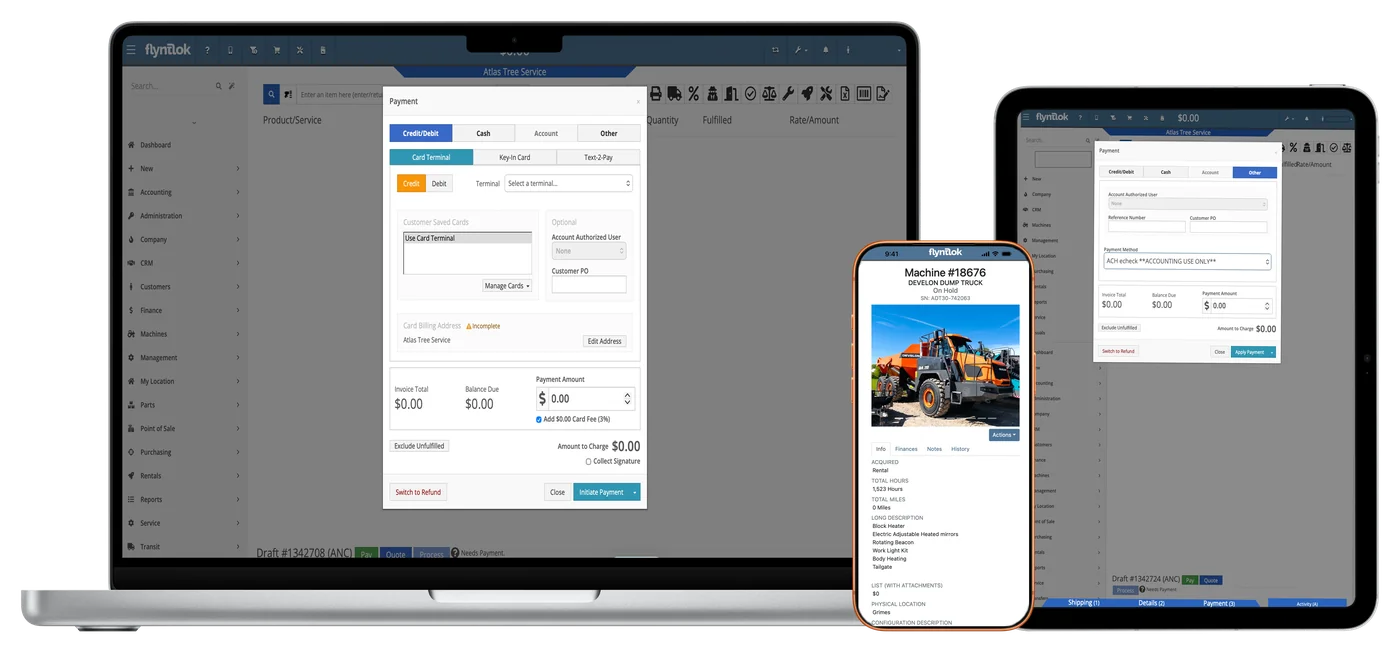
With Flyntlok's integrated Point of Sale (POS) and Gravity Payments, employees can accept payment directly from the Sales Order. Payment information stays connected to the transaction, eliminating the need to manually enter the same amount into a separate system.
One sale. One connected workflow. Less administrative work.
Equipment dealers work hard to protect their margins.
Parts managers monitor pricing. Service managers track labor recovery. Sales teams negotiate machine deals. Owners and controllers watch expenses carefully.
But what about payment processing?
Every card transaction comes with processing costs. Depending on transaction volume, average ticket size, and payment methods, those expenses can become a meaningful line item.
The challenge isn't simply what your processor charges. It's whether your dealership has the flexibility and controls to manage those costs.
Consider a service department processing a large repair invoice. If credit card processing fees aren't accounted for, they reduce the profitability of that transaction.
Dealers may have options to recover certain processing costs through surcharging, subject to applicable laws and card-network rules. But if managing those fees depends on individual employee decisions, recovery can become inconsistent.
The better approach: Build payment-cost controls into your existing sales workflow.
Flyntlok's integrated Gravity Payments solution supports credit card surcharging, allowing dealerships to recover eligible processing costs where permitted.
Flyntlok also gives dealerships control over who can waive card fees. Managers can establish permissions so employees aren't put in the uncomfortable position of deciding whether to remove a fee every time a customer asks.
ACH payments provide another option for qualifying transactions, giving customers payment flexibility while helping dealerships manage acceptance costs.
The goal isn't to add fees indiscriminately. It's to give dealerships greater control over payment costs while maintaining a transparent, convenient customer experience.
Because protecting profitability shouldn't stop when it's time to collect payment.
For dealership controllers and accounting teams, collecting a payment is only the beginning.
The payment must be recorded accurately, matched to the correct transaction, and ultimately reconciled with the money deposited into the dealership's bank account.
When payment processing and accounting operate independently, that work becomes unnecessarily complicated.
Accounting teams may need to compare payment processor reports against DMS transactions, identify missing or mismatched payments, and investigate discrepancies across locations.
And when information is spread across multiple systems, answering even a simple question can become time-consuming:
Did that customer pay? Which invoice was it applied to? Has the deposit reached the bank?
For a multi-location dealership, these challenges multiply.
The better approach: Connect payments to sales and financial records from the start.
With Flyntlok and Gravity Payments, card payments are tied to the original Sales Order, and payment deposits are automatically matched against bank activity.
Flyntlok also integrates with accounting platforms including QuickBooks Online and Sage Intacct, helping dealerships move financial transactions into their books without unnecessary re-entry.
Finance teams retain control through processes such as Flyntlok's Z Detail review and approval workflow, while transaction-level posting visibility makes it easier to identify and investigate issues.
The result is less manual reconciliation, clearer financial records, and more time for accounting teams to focus on the work that actually moves the business forward.
Your customers don't care how many systems your dealership uses.
They just want to pay for their equipment, parts, or repairs and get back to work.
Think about a contractor whose compact track loader is being serviced. The repair is complete, but the customer is on a jobsite and can't return to the dealership to pay.
Or a landscaping company ordering replacement mower parts over the phone. Its crew needs those parts tomorrow morning, but the owner isn't available to stop by with a credit card.
When payment options are limited, even routine transactions become inconvenient.
Employees spend time coordinating payments. Customers make unnecessary trips. Orders can be delayed while everyone figures out how to complete the transaction.
The better approach: Meet customers wherever they're working.
Through Flyntlok and Gravity Payments, dealerships can offer multiple ways to pay:
Payments stay connected to the original sale, regardless of how the customer chooses to pay.
That means less chasing payments for your employees and fewer interruptions for customers who have work to do.
And in an industry where customer relationships are built over years, sometimes generations, making business easier matters.
For dealership owners and executives, disconnected systems create another problem: limited visibility.
When sales, payments, and accounting information live in separate places, understanding what's happening across the business requires additional work.
This becomes particularly challenging for dealerships operating multiple locations.
You may have one store processing a high volume of parts transactions, another handling major equipment sales, and a third managing service and rental payments.
If each location relies on different payment processes or manual reconciliation, maintaining consistent financial controls becomes harder.
It's not just about seeing revenue. It's about understanding how efficiently your business collects and accounts for that revenue.
The better approach: Keep payments connected to the rest of the dealership.
Flyntlok brings sales, parts, service, rentals, customer information, and financial workflows together in one cloud-based DMS.
With integrated payments through Gravity, transactions remain tied to the dealership activity that generated them.
Owners and controllers gain a more connected view of operations, while employees spend less time moving between systems.
As dealerships grow, that consistency becomes increasingly valuable.
If you're evaluating a new DMS or payment processing solution, don't stop at transaction rates.
Ask how the technology supports the entire process, from the initial sale through reconciliation.
Here are six questions worth asking any provider:
The answers will tell you considerably more about the true cost of a payments solution than its advertised processing rate alone.
Equipment dealers shouldn't have to choose between a convenient customer experience and strong financial controls.
With Flyntlok and Gravity Payments, dealerships can accept payments directly within their DMS, offer flexible payment methods, manage eligible credit card surcharges, and reduce the manual work associated with reconciliation.
And because Flyntlok connects payments to the rest of the dealership, from parts and service to equipment sales and accounting, your team can spend less time managing transactions and more time taking care of customers.
Your dealership works hard to earn every dollar. Your payment system should help you keep more of it.
Discover how Flyntlok and Gravity Payments help equipment dealers simplify payment processing, protect margins, and connect transactions to their business operations.

About the author
Jenny Moebius
Chief Marketing Officer
Jenny Moebius is Chief Marketing Officer at Flyntlok, and hosts Flyntlok Unlocked, a podcast for equipment dealers. She brings a 20-year background in growing software businesses and a focus on what technology means for dealers’ bottom lines: giving teams time back, protecting margins, and creating more opportunities for profitable growth.
Connect on LinkedInAccounting & Finance
See Flyntlok in your dealership
Get a demo built around the way your team works today.
Request a demoQuick answers to the questions this article raises.
It's more than the processing fee. When payments run in a separate system from your DMS, staff enter the same amounts twice, update invoices by hand and reconcile payments against sales records, and every extra step is a chance for error.
Dealers may be able to recover certain processing costs through surcharging, subject to applicable laws and card-network rules. Flyntlok's integrated Gravity Payments solution supports credit card surcharging where permitted, and managers can control who is allowed to waive card fees.
Customers can tap, chip or swipe at the counter, pay over the phone with a securely stored card or authorized card entry, pay from their phone through a Text-2-Pay link, or pay by ACH bank transfer. Each payment stays connected to the original sale.
Card payments are tied to the original Sales Order, and deposits are automatically matched against bank activity. Flyntlok also integrates with QuickBooks Online and Sage Intacct, so transactions move into your books without re-entry.
Look past the processing rate. Ask whether payments are built into the DMS, which payment methods customers can use, how the system protects margins, what happens after a payment is processed, whether it works across departments and locations, and how staff can see exactly where a payment stands.
Flyntlok puts Gravity Payments in the sale, so card payments post to the sale and reconcile against your bank deposits.