NEW!
Meet Flyntlok at Equip Expo 2026:
.webp)
September 3, 2026
Adding locations should create greater scale, not more spreadsheets, disconnected processes, or uncertainty. Here’s how equipment dealers can standardize operations, maintain visibility, and protect profitability as they grow.
Growth is a hard-earned milestone for an equipment dealership. As dealerships expand, the requirements for a DMS for multi-location equipment dealers change. The system must do more than run individual branches; it needs to connect inventory, customers, departments, financial information, and workflows across the entire organization.
Acquiring a new location can bring a larger territory, stronger OEM relationships, new customers, more technicians, and greater revenue potential. But whether the dealership expands through acquisition or organic growth, every location also introduces another layer of operational complexity.
Eventually, a dealership can reach a frustrating point: the business is growing, but it is becoming harder to run.
That does not mean the dealership has grown too quickly. It usually means its operational systems have not grown with it.
The goal is not to make every location identical. Each branch may serve a different market, carry different equipment, and have customer relationships built over decades. The goal is to create enough consistency and visibility that every location can benefit from the strength of the entire dealership.
When a dealership operates from one or two locations, leaders can often manage through proximity. They know what is happening because they can walk the floor, speak directly with department managers, and see inventory with their own eyes.
That becomes harder with every new branch: particularly as mid-size and large dealership groups expand across territories, states, OEMs, or acquired businesses.
Without one connected system, routine questions become surprisingly difficult to answer:
When the answers require several reports, calls to branch managers, or a manually assembled spreadsheet, the dealership is already paying a price.
The cost is not limited to administrative time. A lack of visibility can lead to missed sales, unnecessary purchases, excess inventory, inconsistent pricing, slower service, and decisions based on incomplete information.
Growth should create leverage. Disconnected operations create friction instead.
White’s Tractor experienced this fragmentation across its four Bobcat locations. Parts and service operated in one system, rental in another, and sales in a third. After connecting those departments and locations through Flyntlok, owner Stephanie Smith described the difference simply: “It’s a snapshot of the entire company, not just your location.”
Read Bobcat Dealership White’s Tractor’s story.
.webp)
Multi-location dealers need a shared source of operational truth across sales, parts, service, rental, accounting, customers, and equipment.
That does not mean every employee needs access to everything. It means the information used to run the business should come from a connected system, not separate databases or location-specific spreadsheets.
Leadership should be able to see performance across the organization and drill into an individual branch when something needs attention. Department managers should be able to compare relevant operational metrics without first debating whether everyone calculated them the same way.
A connected view helps leaders spot problems earlier, compare locations fairly, and spend less time assembling information before they can act on it.
Inventory visibility is one of the clearest advantages a multi-location dealership can create.
If employees can see only what is available at their own branch, every location operates like a separate business. One store may lose a sale while the exact machine or part the customer needs sits untouched at another location.
A shared inventory view allows teams to:
The question is not simply, “What do we have?” It is, “What do we have across the entire business, and where can it create the most value?”
For White’s Tractor, shared visibility helps employees locate parts across four branches and use a daily courier to move them to the customer, or the technician who needs them, faster.
Operations Manager Drew Marsteller says, “We have a firmer grasp on our parts inventory currently than we have ever had.”
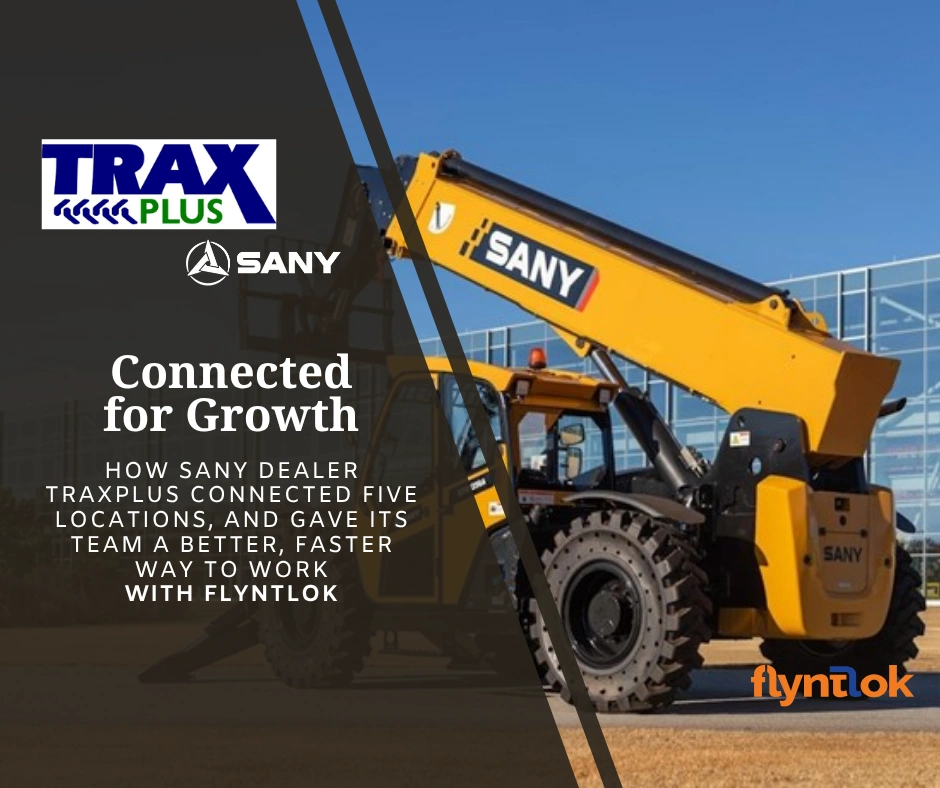
TraxPlus has also seen a similar change across five SANY locations in three states. Employees can check inventory at every branch, request a documented transfer, and use equipment photos to verify a machine’s configuration without calling someone two states away to inspect it physically.
In both cases, connected inventory does more than make information easier to find. It helps the dealerships use what they already own, respond to customers faster, and avoid unnecessary purchases.
Every location develops its own habits. Some local flexibility is healthy, but inconsistency becomes expensive when it affects pricing, inventory, service productivity, customer follow-up, or financial reporting.
A growing dealership should establish shared processes for high-impact activities such as:
Standardization does not need to mean adding more approvals or bureaucracy. Done well, it makes the best way of working the easiest way to work.
The dealership gains more consistent data, employees spend less time navigating exceptions, and customers receive a more reliable experience regardless of which branch they visit.
More data does not automatically create better decisions. Employees need relevant information presented where they are already working.
A dealer principal may need consolidated performance across locations. A service manager needs work-order status, technician capacity, and outstanding estimates. A parts manager needs demand, availability, aging, and margin information. A salesperson needs customer history, equipment ownership, open opportunities, and follow-up activity.
A modern dealer management system should provide each role with the appropriate view while maintaining common underlying data.
That balance matters. Too little access creates bottlenecks. Too much unstructured information creates noise. Role-based visibility lets employees make faster decisions without losing organizational control.
That same principle applies to accounting. Operational teams need the transaction-level detail behind equipment, parts, service, rental, and customer activity. Finance needs accounting controls, consolidated reporting, and the ability to understand performance by location.
With Flyntlok connected to QuickBooks Online or Sage Intacct, dealership activity can be assigned to the appropriate branch while the accounting team maintains the same core chart of accounts. Finance can produce location-level profit-and-loss statements without duplicating unnecessary setup, while operational employees complete their work once inside Flyntlok.
As Flyntlok Lead Accounting Specialist and former dealership controller Nic Thamert explains, “You gain more visibility, actually, with the two systems.”
Watch Flyntlok Unlocked Ep.5: Top 5 Accounting Myths—Busted to see how connected accounting supports multi-location reporting without double entry.

Equipment dealerships are built on relationships. Growth should strengthen those relationships, not fragment them.
When customer information is scattered across individual branches, employees may not see the full history of the account. A salesperson might miss a service issue. A service writer may not know about an upcoming equipment purchase. Another location may contact the same customer without understanding the conversations already underway.
A shared customer record helps the dealership operate as one team. It can connect:
Customers should not have to explain their history every time they work with a different department or location. The dealership’s system should carry that context forward.
Adding a location is not complete when the agreement is signed or the doors open. The real operational work begins when employees, customer records, inventory, accounting structures, and day-to-day processes must come together.
A repeatable integration plan should answer several questions early:
The technology should support this plan—not become another integration project within it.
Cloud-based systems can make it easier to onboard users, establish consistent permissions, deploy shared workflows, and give leadership visibility without maintaining different software environments at each branch.
TraxPlus knew its next system needed to support continued expansion, not become another constraint. As Director of Operations Cody Savell explained, “We were looking for somebody that could grow with us.”
Ease of adoption was part of that scalability. Employees became comfortable with Flyntlok from day one, while leadership gained one connected operating system for sales, parts, service, rental, accounting, equipment, and customer information across all five locations.
Read how SANY dealership TraxPlus connected five locations with Flyntlok.
Multi-location control does not require eliminating everything that makes each branch successful.
Dealers should generally standardize the processes that affect financial integrity, customer continuity, inventory accuracy, and organization-wide reporting. These might include data definitions, pricing permissions, work-order stages, equipment records, accounting connections, and core KPIs.
Local teams may still need flexibility in areas such as:
The objective is not sameness. It is alignment.
Each location should retain the ability to serve its market while contributing reliable information to the larger business.
Before opening or acquiring a location, dealership leaders should ask:
These questions can also reveal whether your current dealer management system is ready to scale with you. If you are evaluating a new DMS, do not settle for a feature checklist or a vendor-led overview. Ask every provider to demonstrate how its system handles real cross-location workflows—from finding and transferring inventory to reporting by branch and calculating the full cost of adding locations.
The Equipment Dealer’s DMS Buyer’s Checklist gives you the requirements, real-world demo scenarios, disqualifying questions, and vendor scorecard to evaluate every platform on equal terms. Bring it to each demo and make the vendor show how its system will support your dealership—not just today, but at the next location and every one after that.

Flyntlok brings equipment sales, parts, service, rental, CRM, inventory, accounting, and operational reporting together in one cloud-based dealer management system.
Multi-location dealers can give teams access to shared customer and equipment information, see inventory across branches, establish consistent workflows, and gain a clearer view of performance throughout the organization.
The result is not simply better software visibility. It is greater operational control:
White’s Tractor and TraxPlus are different dealerships, representing different manufacturers and serving different markets. But both reached the same realization: adding locations increases the value of connected operations.
White’s gained a company-wide view across four Bobcat locations. TraxPlus gave employees across five SANY locations a faster, more dependable way to find information and complete everyday work.
Their experiences demonstrate what profitable multi-location growth requires: shared visibility without constant calls, standardized workflows without unnecessary rigidity, and technology that helps every location operate as part of one dealership.
Growth will always introduce complexity. The right DMS turns that growing footprint into an advantage.
A multi-location equipment dealer should look for a cloud-based DMS that connects inventory, customers, sales, service, parts, rentals, and financial data across every location. The right system should provide centralized visibility while still giving individual branches the flexibility to manage day-to-day operations. It should also support consolidated reporting, cross-location inventory visibility, standardized workflows, integrations, and the ability to scale as the dealership adds locations.
A DMS helps multi-location dealerships operate as one connected business instead of a collection of separate branches. Leaders can see performance across locations, employees can access shared customer and equipment information, and teams can locate inventory across the dealership network. This reduces duplicate work, improves coordination, and gives management a clearer view of where revenue, margin, and operational issues exist.
Yes. A modern dealer management system should allow dealership leaders to view performance across individual branches as well as the entire organization. Consolidated reporting can help management compare locations, monitor sales and service performance, understand inventory levels, and identify opportunities to improve profitability without manually combining data from separate systems or spreadsheets.
The goal is to standardize the processes that benefit from consistency while preserving flexibility where local teams need it. A multi-location DMS can establish shared workflows, customer records, reporting standards, permissions, and inventory visibility across the organization while still allowing individual locations to manage their own customers, employees, inventory, and day-to-day decisions. This gives dealership leadership greater control without creating unnecessary friction at the branch level.
When locations cannot easily see inventory across the dealership network, teams may order equipment or parts that already exist at another branch, miss opportunities to fulfill customer demand, or carry unnecessary inventory. Cross-location visibility helps dealers make better use of existing stock, transfer inventory where demand is highest, and reduce unnecessary carrying costs.
Dealers should reevaluate their DMS when adding locations creates more manual reporting, inconsistent processes, disconnected customer records, inventory blind spots, or difficulty understanding performance across the business. Ideally, dealerships should address these issues before expansion accelerates so the technology can support growth rather than become a constraint.
Planning for your next stage of growth? See how Flyntlok helps multi-location equipment dealers connect their operations, improve visibility, and scale with greater control. Schedule a demo with us.