NEW!
Meet Flyntlok at Equip Expo 2026:
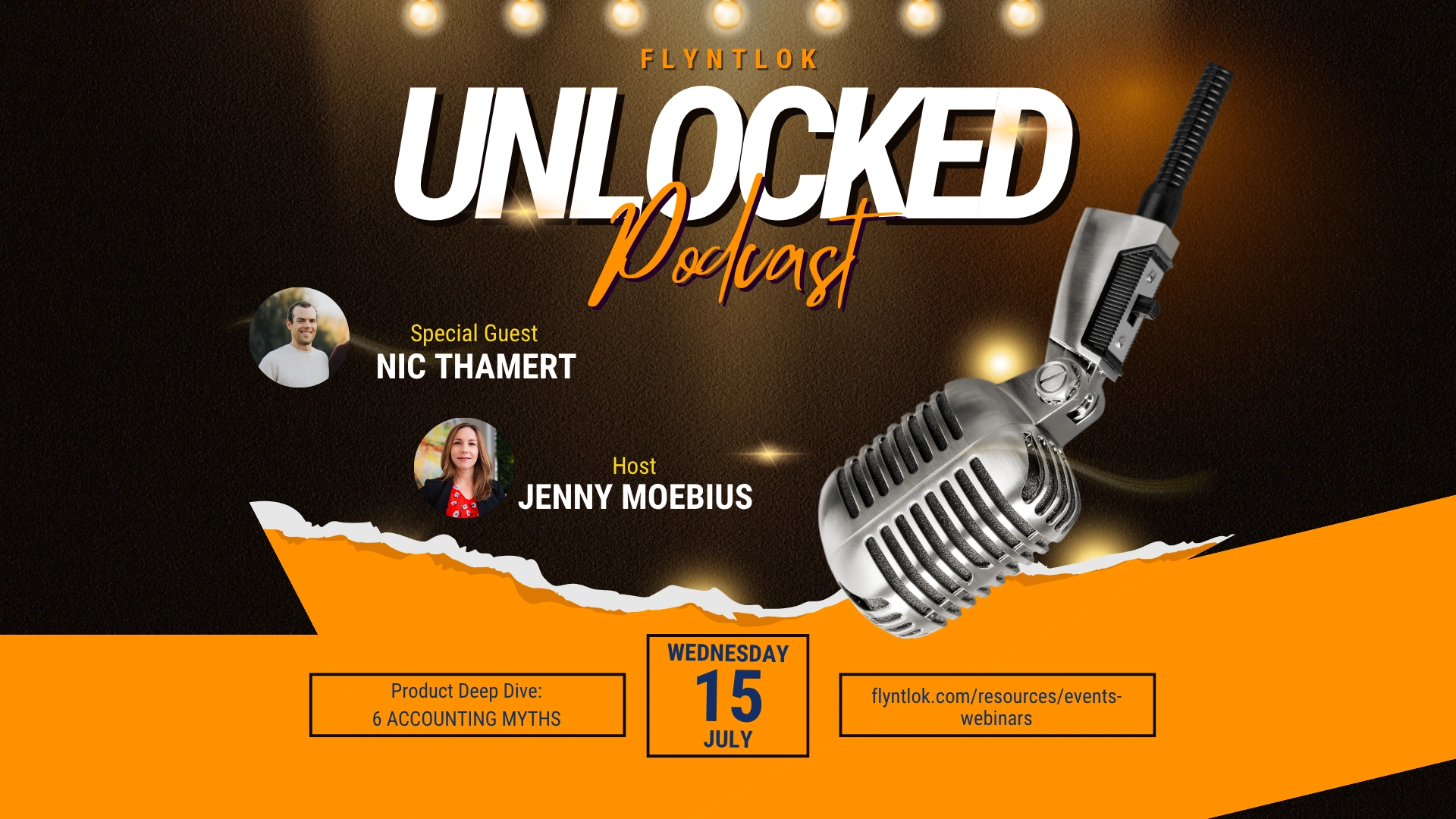
Welcome back to Flyntlok Unlocked — the podcast where we go behind the scenes, unlocking Flyntlok product insights with the people building and implementing the tools, YOU, equipment dealerships use every day.
Thank you for joining us!
I’m your host, Jenny Moebius, Flyntlok’s CMO, and today we’re doing something a little different.
Rather than walking through every accounting workflow, we’re taking the five biggest myths we hear about using Flyntlok with QuickBooks Online and Sage Intacct… and putting a few to the test with a live demo.
One of the most common questions dealerships ask when evaluating Flyntlok is:
Where’s the accounting?”
It’s a fair question. Many legacy systems bundled accounting and dealership operations together.
Flyntlok takes a different approach: It’s built to run the operational side of the dealership (we call it the dealership’s operational heartbeat!), while QuickBooks Online or Sage Intacct is built to manage the financial books. The integration connects the two so dealers can use specialized, best-in-class tools without recreating the work.
Quick side note: We’re going to focus the majority of pod on Quickbooks. For a Sage Intacct review, head on over to our Resources section of our website to listen in on the webinar Gain Better Financial Visibility with Flyntlok + Sage Intacct with our partner Baker Tilly and CFO of Craig Taylor Equipment Thomas Huling.
--
Host: Jenny Moebius, CMO, Flyntlok
Guest: Nic Thamert, Lead Accounting Specialist, Flyntlok
For many equipment dealerships, accounting is one of the biggest questions that comes up when evaluating a new dealership management system.
Where does the accounting happen? Will employees need to enter transactions twice? Will finance lose visibility? Will month-end close become more complicated?
These concerns are understandable. Many legacy DMS platforms bundled accounting and dealership operations into a single system. Flyntlok takes a different approach: Flyntlok serves as the dealership’s operational heartbeat, while QuickBooks Online or Sage Intacct manages the financial books.
The systems are connected through an integration, allowing each platform to do what it does best without requiring the dealership to recreate its work.
In Episode 5 of Flyntlok Unlocked, host and Flyntlok CMO Jenny Moebius sits down with Lead Accounting Specialist Nic Thamert to address the most common misconceptions about this model—and put several of them to the test with real product demonstrations.
Before joining Flyntlok, Nic served as the financial controller at Northland Farm Systems, a farm and construction equipment dealer in Minnesota. In that role, he used Flyntlok alongside QuickBooks Online to manage the dealership’s financial operations.
That firsthand experience gives Nic a particularly valuable perspective: He has worked with the integration both as a dealership controller and as the person now helping other dealerships implement it.
Today, Nic helps Flyntlok customers structure their books, build stronger accounting processes, connect dealership activity to financial results, and get clearer visibility into business performance.
Outside of accounting, Nic is also surprisingly handy. He and his wife plan to build a home in the country—and Nic hopes to act as the general contractor and complete much of the framing, electrical, and plumbing himself.
The simplest explanation is that Flyntlok manages the operational side of the dealership, while QuickBooks Online or Sage Intacct manages the financial ledger.
Dealership employees use Flyntlok for their everyday workflows, including:
The appropriate financial information is then sent to QuickBooks based on account mappings established during implementation.
QuickBooks sends relevant information back to Flyntlok as well. For example, when a customer payment is applied to an invoice in QuickBooks, the updated payment status can be displayed in the customer’s Flyntlok record.
The result is a connected process: Operational teams retain the dealership-level detail they need, while finance gets the accounting controls and reporting it needs.
“We try to be the best we possibly can at being your DMS, and we tie into two of the top accounting services. That way, you get the best of both.” — Nic Thamert
This is one of the most common misconceptions dealerships have about using a separate DMS and accounting platform.
If the transaction begins in Flyntlok but the books live in QuickBooks, does someone have to enter the transaction again?
The answer is no.
During the episode, Nic demonstrates a simple parts sale in Flyntlok. The dealership sells a bolt to a customer and charges the purchase to the customer’s account. When the invoice is viewed in QuickBooks, the same information appears there, including:
The employee completes the sale once as part of the normal Flyntlok workflow. The integration translates that activity into the appropriate accounting transaction in QuickBooks.
“You do it once in Flyntlok, and then it goes straight into QuickBooks. There’s no need to redo the work twice.” — Nic Thamert
Most dealerships review and post transactions daily, either at the end of the day or the beginning of the next. The dealership controls when transactions are pushed, giving the accounting team an opportunity to verify activity or reconcile an account before posting.
Myth busted: The work is completed once in the dealership workflow. The integration turns that activity into the corresponding accounting transaction.
Dealership leaders may worry that keeping the general ledger in QuickBooks will force employees to jump between systems all day—or prevent operational teams from seeing important financial information.
In practice, the integration provides two complementary levels of visibility.
Flyntlok holds the detailed operational information behind each transaction. QuickBooks provides purpose-built financial records, reporting, and accounting controls. Relevant information then flows between the two systems.
For example, parts counter employees can view a customer’s invoice history and see which invoices have been paid directly within Flyntlok. They do not need access to QuickBooks or assistance from the accounting team to answer a basic customer question.
At the same time, finance can use QuickBooks to manage the ledger, produce financial statements, and apply payments without asking operational employees to work inside the accounting platform.
“You gain more visibility, actually, with the two systems.” — Nic Thamert
This division can also provide an added layer of business continuity. If one platform is temporarily unavailable, the dealership still retains access to important information in the other.
Myth busted: Dealers do not lose visibility. Operational teams retain the dealership detail they need, while finance gains the reporting and controls of a dedicated accounting platform.
Dealership accounting teams often assume that using two connected systems will make reconciliation and month-end close more complicated.
Nic experienced the opposite while working as a dealership controller.
Flyntlok provides detailed visibility into dealership assets and activity, including equipment inventory, parts, acquisition types, and the payment status of individual machines. QuickBooks then provides bank feeds and transaction-matching tools that help the accounting team reconcile financial activity as it occurs.
A connected bank or credit-card feed displays new transactions inside QuickBooks. Nothing is officially recorded until the accounting team reviews the activity and directs it to the appropriate account. Once a transaction is matched or categorized, the team is simultaneously recording the expense and progressing through reconciliation.
Instead of waiting until the end of the month to review every line of a bank statement, the dealership can reconcile activity throughout the month. When month-end arrives, most of the work has already been completed.
Nic shared that a bank reconciliation that once took him two or three hours could take only a few minutes in QuickBooks after the daily transactions had been properly reviewed and matched.
That result depends on establishing accurate mappings and maintaining consistent processes—which is why Flyntlok works with dealerships to configure and validate the integration before go-live.
Myth busted: A purpose-built accounting platform can reduce manual reconciliation and make month-end easier, especially when transactions are mapped correctly and reviewed regularly.
Another common concern is that an integration will automatically send transactions into the general ledger, allowing employee mistakes to damage the dealership’s books.
The separation between Flyntlok and QuickBooks can actually strengthen internal controls.
Most dealership employees do not need direct access to QuickBooks. Technicians, parts employees, salespeople, and other operational users work within Flyntlok, where role-based permissions determine what each person can see and do.
Those permissions can be configured around the dealership’s organization and workflows. Access can be assigned by department, role, responsibility, or individual employee instead of forcing everyone into a small number of standardized permission levels.
Meanwhile, access to QuickBooks can remain limited to the accounting team, owners, or other qualified employees. That helps prevent unauthorized journal entries, changes to closed periods, or accidental edits to historical invoices.
Transactions also do not have to “fly into” QuickBooks without review. The dealership controls which transactions are posted and when they are sent. Once mappings are properly configured, they create consistency around where each type of dealership activity appears in the financial statements.
This structure provides several layers of protection:
Myth busted: Separating dealership workflows from the financial ledger can create more control—not less.
QuickBooks is widely used, which makes it easier for dealerships to find bookkeepers, accountants, and financial professionals who already know the platform.
But equipment dealers have specialized accounting requirements. They need to account for equipment inventory, floor plans, lender fees, warranties, multiple locations, fixed assets, and other workflows that a general accounting platform may not understand on its own.
This is where Flyntlok provides the dealership-specific context.
Warranty claims can become especially complicated when part of a repair must be billed to a customer and another part must be billed to a manufacturer or vendor.
In Flyntlok, the dealership can complete the service work once and separate the billing appropriately. Teams can also track warranty activity by vendor to understand how much the dealership is recovering—and where warranty work may be eroding service profitability.
When equipment enters inventory, it can be identified as floor-planned and mapped to the correct liability account.
Dealerships with multiple floor-plan providers can use separate liability accounts to understand how much is owed to each lender. Because the machines are individually visible in Flyntlok, teams can also see which units have and have not been paid.
That visibility helps dealership leaders manage cash and distinguish between short- and longer-term floor-plan obligations.
Flyntlok, QuickBooks Online, and Sage Intacct can support multi-location dealership structures without requiring the accounting team to build an entirely separate chart of accounts for every branch.
A dealership can use the same core accounts while assigning activity to the appropriate location. Transactions originating at Location A or Location B can be directed accordingly and reported by location inside the accounting platform.
This allows finance teams to produce location-level profit-and-loss statements and other financial reporting without duplicating unnecessary setup.
Flyntlok tracks machines at the unit level, including whether a machine is new, used, or held as a fixed asset. Nic also highlighted Flyntlok’s ability to support fixed-asset schedules and monthly depreciation, potentially reducing the dealership’s reliance on separate tools or outside services.
Myth busted: QuickBooks manages the financial ledger, while Flyntlok adds the equipment-specific workflows and unit-level detail dealerships require.
This concern is less about the technology and more about accountability.
Dealers do not want to report a problem to Flyntlok, be told it belongs to QuickBooks, contact QuickBooks, and then get sent back to Flyntlok.
Nic’s answer was simple: Flyntlok takes ownership.
Flyntlok supports the integration as one connected process—from initial configuration and account mapping through workflow validation, employee training, and ongoing dealership use.
Nic and other members of the team have QuickBooks expertise and certifications, allowing them to help customers with many questions without sending them elsewhere. Only an unusual issue within QuickBooks’ underlying platform would typically require direct escalation to Intuit.
This support is backed by Flyntlok’s “8 and 8” commitment: responding to customers within eight minutes and working to resolve their issue within eight hours.
“It’s very rare that any of our clients ever have to call QuickBooks.” — Nic Thamert
Myth busted: A separate accounting platform does not have to mean fragmented support. Flyntlok supports the implementation, mappings, integration, and dealership workflows as a connected experience.
Having experienced the system as both a controller and implementation specialist, Nic sees several benefits dealerships tend to recognize quickly:
The connected approach allows Flyntlok to retain the operational detail dealership teams use to manage the business without forcing all of that complexity into the accounting system.
Finance gets cleaner books. Operational teams get the workflows and reporting they need. Leadership gets a more complete picture of dealership performance.
The real question is not whether accounting matters. It is whether one platform can realistically be best in class at both dealership operations and financial accounting.
Flyntlok gives dealership teams the detailed workflows they need to manage equipment, parts, service, sales, rentals, and customers. QuickBooks Online or Sage Intacct gives finance teams the controls, reporting, and familiar accounting environment they need to manage the books.
The integration connects the two without asking employees to enter everything twice.
Flyntlok also helps configure the integration, validates the setup before go-live, trains dealership teams, and supports customers when questions arise. Dealers get the specialized capabilities of two best-in-class platforms—with a connected process and a team accountable for making it work.
As Nic put it when asked what he would tell a dealership that was still nervous about using QuickBooks Online:
“You’ve got me.”
Ready to see how Flyntlok and QuickBooks Online or Sage Intacct can work together for your dealership? Schedule a personalized demo.