WATCH HERE:
Our Equip Expo AI Session is Now On-Demand!
Key takeaways
Every forklift a material handling dealer sells is the beginning of a much longer customer relationship.
That lift truck will need planned maintenance. Replacement parts. Emergency repairs. Perhaps a rental unit when it's out of service. And eventually, when the time is right, a replacement.
Each of those interactions represents an opportunity to generate revenue, strengthen customer loyalty, and build a more profitable dealership.
But capturing that opportunity isn't automatic.
For material handling dealers, growth isn't just about selling more forklifts, lift trucks, or warehouse equipment. It's about getting more value from the equipment already operating in customers' facilities, and doing it without adding unnecessary complexity or costs to the business.
The next growth opportunity for material handling dealers may already be sitting in their customers' fleets.
Equipment sales will always be an important part of the material handling business. But they aren't the only measure of a dealership's financial health.
In fact, the Material Handling Equipment Distributors Association (MHEDA) has long emphasized the importance of aftermarket operations, including parts, service, and rental, to distributor profitability.
In its article, Benchmarking Crucial Profit Variables, MHEDA highlights a powerful financial objective: aftermarket gross profit should cover 100% of a dealership's operating expenses.
The analysis also identifies service as a particularly important contributor to the bottom line and emphasizes the importance of technician productivity, parts margins, and rental fleet profitability.
The takeaway? A profitable material handling dealership doesn't rely exclusively on its next equipment sale. It builds a business that continues generating value throughout the equipment lifecycle.
The challenge is making sure your operations are connected well enough to capture that value.
Here are five opportunities to start.
For forklift and industrial truck dealers, planned maintenance (PM) contracts are more than scheduled service appointments. They are an opportunity to build recurring revenue and become an indispensable partner in customers' operations.
Warehouse and distribution center operators depend on equipment uptime. A forklift that isn't running can disrupt picking, shipping, production, and other critical activities.
Dealers that proactively manage maintenance can help customers avoid unnecessary downtime while creating a more predictable service business.
But managing PM agreements across dozens, hundreds, or even thousands of customer-owned units gets complicated quickly.
Each piece of equipment may have different maintenance intervals based on operating hours, calendar schedules, or both. Each customer may have different contract terms. And each service visit needs to be tracked against the right equipment and agreement.
When those details live in spreadsheets, disconnected service systems, or manual schedules, opportunities can slip through the cracks.
A connected dealer management system (DMS) helps dealers:
The goal isn't simply to complete more service appointments. It's to make every agreement more manageable, measurable, and profitable.
The profitability opportunity: More consistent recurring revenue, fewer missed maintenance opportunities, and better visibility into the true cost of servicing customer fleets.
Unlike a dealership where equipment primarily comes into a service bay, material handling dealers often bring the service department directly to the customer.
Technicians travel between warehouses, industrial sites, and distribution centers, diagnosing and repairing equipment in the field.
That makes technician productivity a different kind of challenge.
Every additional trip for a missing part, every phone call to confirm service history, and every hour spent completing paperwork takes time away from work that generates revenue.
And adding more technicians isn't always a simple solution.
What if the dealership could increase the productive capacity of its existing service team instead?
Consider a technician arriving to repair a forklift at a customer's distribution center.
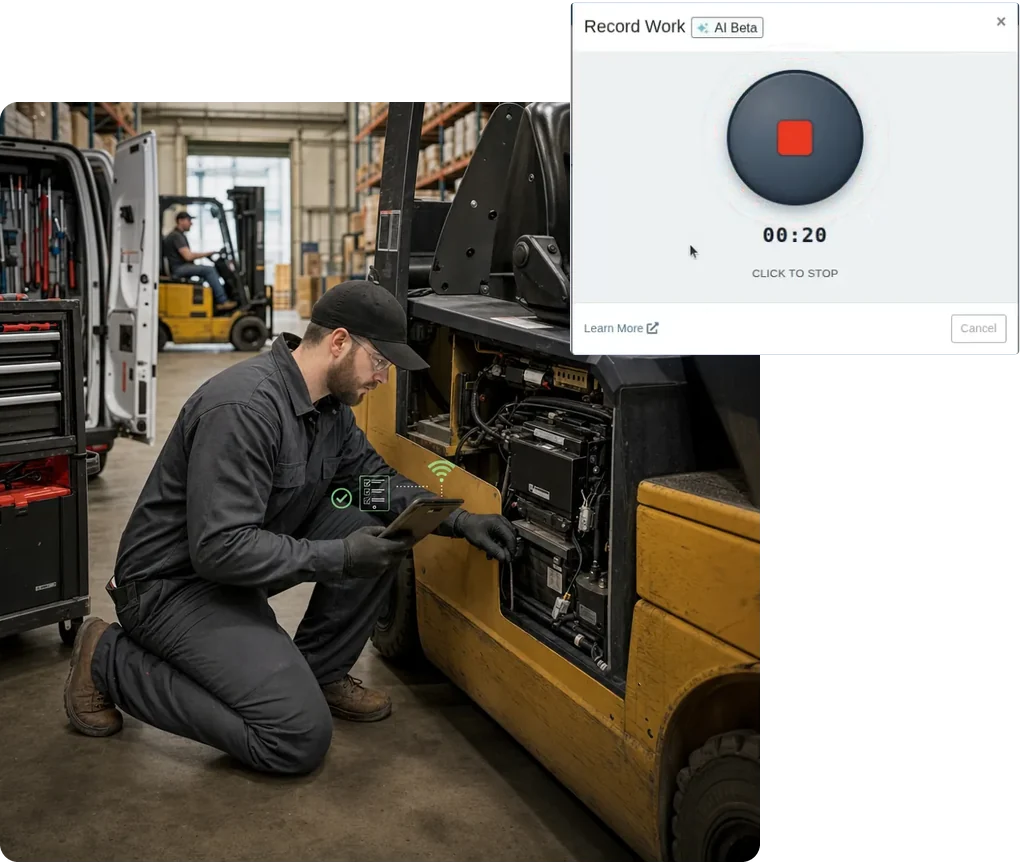
With a connected, mobile-accessible DMS, that technician can review the machine's service history, identify previously replaced components, check parts availability, document findings, and record labor directly from the customer site.
The service department has access to the same information, eliminating the need to re-enter paperwork when the technician returns.
AI can help reduce administrative work even further.
With Flyntlok's Smart Tech Notes, technicians can speak naturally about the repairs they've completed, and AI transforms their explanation into structured, professional service notes for review.
That means less time typing and rewriting documentation, while preserving the information the next technician, service writer, or customer may need.
It's also important to distinguish between travel time and wrench time. When dealerships can track both, managers gain a clearer picture of where technician capacity is being consumed.
The profitability opportunity: More productive technician hours, better service documentation, and less administrative work without immediately increasing headcount.
Rental plays a unique role in material handling.
A customer may need a short-term forklift while a permanent unit is being repaired. Another may need additional lift trucks during a seasonal demand spike. Others may want to evaluate equipment before committing to a purchase.
These scenarios create revenue opportunities, but rental fleets also represent a substantial capital investment.
According to MHEDA's distributor benchmarking analysis, rental profitability must be considered alongside the capital required to maintain and expand the fleet.
That makes an important question worth asking:
Are you maximizing the earning potential of the rental equipment you already own?
A rental unit sitting idle while waiting for inspection, maintenance, or administrative processing isn't generating revenue.
Neither is a unit that is available at one branch but invisible to a rental manager at another.
Improving profitability starts with visibility into the entire rental lifecycle:
When rental operations are connected to service, parts, and accounting, the handoffs become easier to manage.
A returning forklift can move through inspection and any necessary service work before becoming available for the next customer. Rental managers can see availability and utilization, while accounting has visibility into the associated transactions.
The result is an opportunity to increase earning capacity without automatically investing in more equipment.
The profitability opportunity: Better fleet utilization, faster rental turnaround, more accurate billing, and stronger returns on existing rental assets.
Your dealership already has valuable information about its customers.
You know which forklifts they own. You know their service histories. You know which machines are aging, which parts they purchase, and when they last interacted with your team.
But is that information being used to generate new business?
Too often, customer data is scattered between the service department, parts counter, sales team, and CRM.
That creates missed opportunities.
Imagine a customer operating 20 lift trucks across three distribution centers.
Your dealership has serviced several of those units over the past year. A few are approaching important maintenance intervals, and others have experienced recurring repairs.
That information could help a salesperson or account manager start a valuable conversation about planned maintenance, equipment replacement, or rental coverage.
But only if they can see it.
When CRM is built directly into the DMS, customer relationships become more than a record of sales calls and opportunities.
Sales teams can access the operational history behind each customer relationship and use it to identify timely, relevant reasons to reach out.
Flyntlok's built-in CRM and AI-powered Smart Campaigns help dealers put their existing customer data to work, supporting targeted outreach based on customer and dealership information.
Instead of sending the same promotion to everyone, dealerships can develop more relevant campaigns and follow-up activities based on actual customer needs.
And because the customer relationship doesn't end at the sale, neither should your CRM strategy.
The profitability opportunity: More repeat business, better customer retention, and more opportunities to grow revenue from relationships you've already earned.
Revenue growth is important. But revenue alone doesn't tell you whether your dealership is becoming a stronger business.
A service department can be busy without achieving its margin goals. A rental fleet can generate steady revenue while tying up too much capital. A large maintenance agreement can appear attractive until labor and parts costs are taken into account.
And for multi-location material handling dealers, understanding performance becomes even more challenging.
This is where connected operational and financial data makes a difference.
Instead of looking at sales, service, parts, and rental as separate businesses, dealership leadership needs to understand how each department contributes to overall profitability.
That means asking questions like:
These are precisely the kinds of operational and financial measures emphasized in MHEDA's distributor benchmarking work.
Benchmarking provides valuable context. But to act on those insights, dealers also need reliable information from inside their own businesses.
A connected DMS, combined with strong accounting integrations and dealership reporting, helps leadership monitor performance and identify where adjustments can have the greatest impact.
The profitability opportunity: Better decisions about staffing, inventory, service pricing, rental investments, and branch performance, based on actual business data rather than assumptions.
There's a reason these five opportunities are connected.
Planned maintenance drives service work. Service work consumes parts and technician time. Rental keeps customers operating when equipment is unavailable. Every interaction creates valuable customer information. And all of it ultimately affects dealership profitability.
When each department operates in a separate system, the business loses visibility into the complete customer and equipment lifecycle.
Employees spend time moving information between tools. Managers struggle to reconcile reporting. Sales teams miss customer signals. And opportunities to protect margins get harder to identify.
The real advantage of a connected dealership is that every department can work from the same information.
That is the thinking behind Flyntlok.
Built by a former equipment dealer, Flyntlok brings service, parts, rental, sales, CRM, and reporting together in one cloud-native DMS, with accounting integrations that connect operational activity to financial reporting.
As a proud member of MHEDA, we're committed to understanding the challenges facing material handling distributors and industrial truck dealers, and building technology that helps their teams operate more productively and profitably.
It's not about adding another layer of technology to an already complicated business.
It's about giving your people better tools, better information, and more time to take care of customers.
Material handling dealers play an essential role in keeping warehouses, distribution centers, and industrial operations moving.
Their customers depend on reliable equipment, responsive service, and partners who understand that downtime is costly.
For dealerships, meeting those expectations creates an opportunity that extends well beyond the original equipment sale.
It means building stronger planned maintenance programs. Making every technician hour count. Keeping rental equipment earning. Using customer information to drive more relevant conversations. And understanding where the business is generating real profit.
You don't necessarily need more equipment, more people, or more systems to find your next growth opportunity.
You may simply need to get more value from the customers, equipment, and operations you already have.
Because when your entire dealership works together, productivity improves, profitability becomes easier to manage, and your people can focus on what matters most: taking care of the customers who depend on you.
Flyntlok helps forklift and material handling dealers connect field service, planned maintenance, parts, rental, sales, and customer relationships in one cloud-based dealer management system.
Explore Flyntlok for Material Handling Dealers →
Already evaluating your dealership's technology? Read our guide to evaluating material handling dealer management software to learn which capabilities matter most.

About the author
Jenny Moebius
Chief Marketing Officer
Jenny Moebius is Chief Marketing Officer at Flyntlok, and hosts Flyntlok Unlocked, a podcast for equipment dealers. She brings a 20-year background in growing software businesses and a focus on what technology means for dealers’ bottom lines: giving teams time back, protecting margins, and creating more opportunities for profitable growth.
Connect on LinkedInService
See Flyntlok in your dealership
Get a demo built around the way your team works today.
Request a demoQuick answers to the questions this article raises.
In Benchmarking Crucial Profit Variables, MHEDA highlights the objective of aftermarket gross profit covering 100% of a dealership's operating expenses, with service as a particularly important contributor.
Use a DMS that schedules maintenance by hour-meter readings, calendar intervals or both, keeps equipment history by serial number, and tracks labor and parts costs against each agreement so you can see which contracts need attention.
Give technicians mobile access to service history, parts availability and labor entry at the customer site, cut typing with Flyntlok's Smart Tech Notes, and track travel time separately from wrench time to see where capacity goes.
Start with the fleet you own. Units waiting on inspection, service or paperwork, or invisible to other branches, aren't earning. Connecting rental to service, parts and accounting can raise earning capacity without automatically buying more equipment.
Flyntlok gives material handling dealers PM schedules, road service and rental contracts in the same DMS as parts and accounting, so techs can close the job at the customer's dock.