NEW:
Turn Customer Data into Revenue with AI-Powered Smart Campaigns
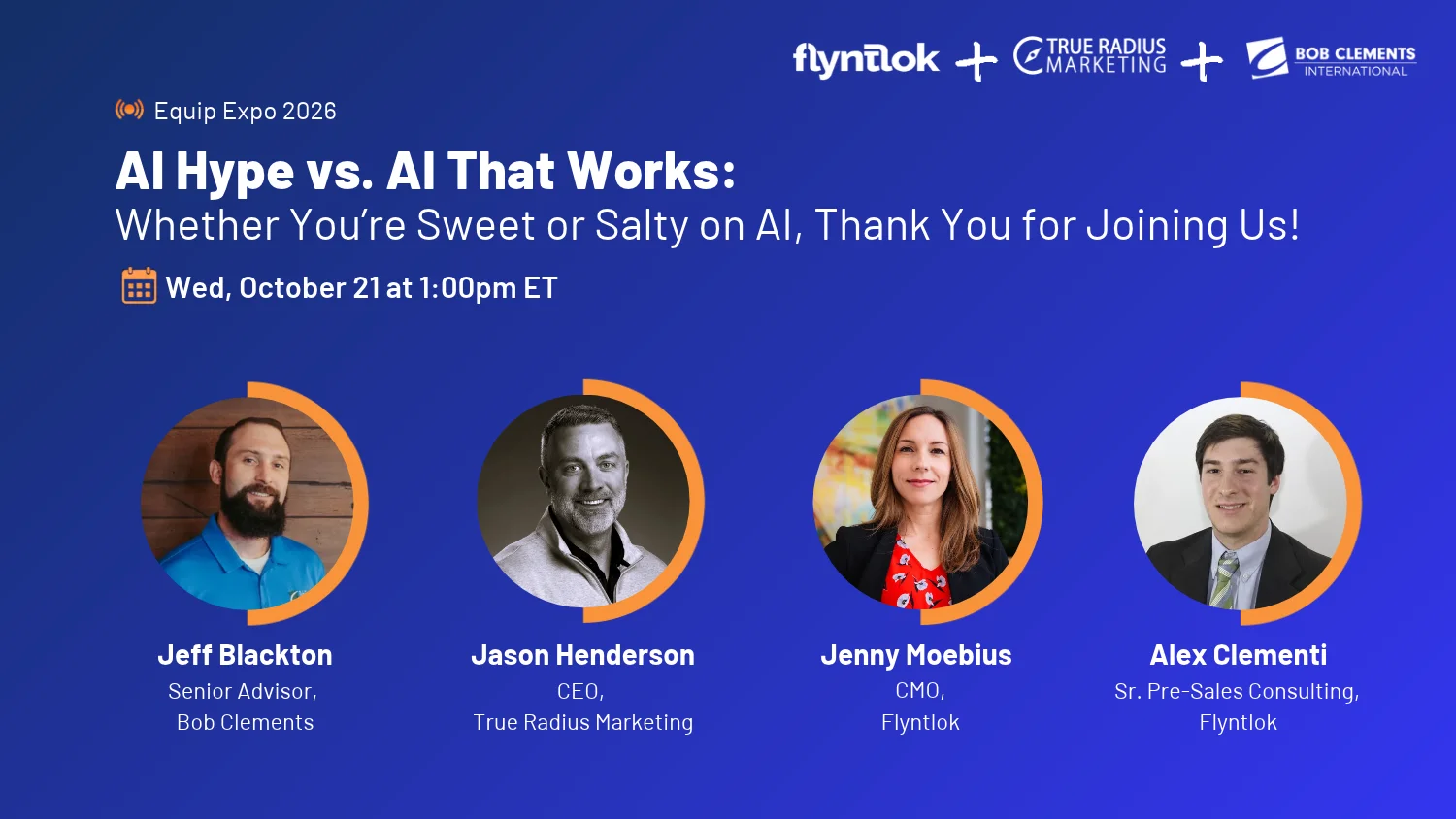
Join us for the on-demand version of our AI session at Equip Expo 2026! Whether you're sweet or salty on AI, we explore how AI can help dealership teams reduce administrative work, make better use of their data, and spend more time on the work that actually drives the business.
The goal isn’t AI for AI’s sake. It’s finding practical ways technology can help dealership employees get more done without adding more work.
--
Live from Equip Expo 2026: How AI Is Helping Dealerships Save Time, Protect Margins, Win Customers, and Grow Revenue
Featuring:
Artificial intelligence is everywhere. It's in the headlines, on the show floor, and increasingly in the conversations happening inside equipment dealerships.
But for dealers juggling parts orders, service backlogs, customer follow-ups, and the never-ending challenge of finding good employees, there's a much more important question than what AI can do.
What can AI actually do for my dealership?
At Equip Expo 2026, Flyntlok joined forces with Bob Clements International (BCI) and True Radius Marketing (TRM) to answer that question in a session titled AI Hype vs. AI That Works.
Rather than talking about futuristic possibilities or technology for technology's sake, the panel focused on practical applications that equipment dealers can use to improve their businesses today.
Jeff Blackton of BCI brought his perspective from years of helping dealerships improve operational performance and profitability. Jason Henderson of TRM explored how AI is changing the way customers find equipment dealers online. Flyntlok CMO Jenny Moebius connected those opportunities to everyday dealership challenges, while Flyntlok's Alex Clementi demonstrated three AI-powered features designed to eliminate repetitive work and create new revenue opportunities.
Together, they explored how AI can help dealerships receive parts faster, simplify technician documentation, reach customers more effectively, and improve visibility in a changing digital landscape.
The message throughout the session was clear:
AI isn't about replacing the people who make dealerships successful. It's about giving them more time to do the work that matters.
Jeff Blackton opened the conversation with a question that immediately resonated with the dealers in the room.
What's one of the biggest expenses in your business?
Payroll.
And while payroll is necessary to run a successful dealership, the time employees spend on repetitive or inefficient tasks represents a significant opportunity to improve profitability.
As Jeff put it:
"Wasting time is wasting payroll."
Think about how much time dealership employees spend manually entering parts information, tracking down incomplete technician notes, or finding customers who are due for service.
Each activity may seem routine. But across multiple employees, departments, and transactions, those minutes add up.
Jeff challenged dealers to look at AI through that lens.
If technology can eliminate repetitive administrative work, employees can devote more of their paid hours to productive activities, customer service, and revenue-generating opportunities.
And that doesn't necessarily mean working harder.
It means making better use of the time employees already spend at work.
Jeff also reinforced an important point about the role of technology in the industry.
"We are still in the human business."
Dealerships grow through relationships, trust, expertise, and the people who support their customers. AI should strengthen those relationships by removing the work that distracts employees from them.
Jenny introduced a framework that carried through the rest of the presentation: AI should help dealerships become more productive, more profitable, and better able to take care of their people.
With that foundation, the session turned to three common dealership challenges and live demonstrations of how Flyntlok is addressing them.
Every equipment dealer understands the frustration.
A shipment arrives. The packing slip needs to be checked. Parts need to be counted. Quantities and prices need to be verified against the purchase order. And all of that information needs to make its way into the dealership management system.
Meanwhile, the phone rings, customers arrive at the counter, and employees are pulled in multiple directions.
Jeff challenged the audience to consider whether their dealerships could consistently receive, enter, and put away incoming parts within an hour of delivery.
For some dealers, that's already an operational goal. But achieving it requires disciplined processes and efficient systems.
That's where Flyntlok Smart Receive comes in.
During the live demonstration, Alex Clementi opened a purchase order containing 40 unique parts and showed how Smart Receive uses AI to interpret invoice or packing slip information.
Instead of manually entering information line by line, employees can upload the document directly into the purchase order.
Flyntlok then analyzes the file and populates the relevant receiving information.
Depending on the document and workflow, Smart Receive can help employees:
The key change is that employees shift from manually entering information to reviewing what the system has captured.
And that distinction matters.
AI handles the repetitive data entry. Employees remain responsible for verifying the shipment.
Alex emphasized that physical parts still need to be counted. The system can interpret what a document says was shipped, but employees must confirm what actually arrived.
That human review provides an important safeguard while eliminating much of the administrative effort.
For parts departments managing high transaction volumes and constant interruptions, the opportunity is significant.
The result is less time spent rekeying information, faster receiving workflows, and more time available to serve customers and get parts where they belong.
The next challenge took the discussion into the service department.
Jeff asked the audience how many technicians genuinely enjoy typing detailed repair notes.
The response was unsurprising.
He then asked how many dealers consistently receive all the information they need from a technician the first time.
Again, the reaction reflected a familiar frustration.
Technicians may be excellent at diagnosing and repairing equipment, but documenting that work isn't always their favorite responsibility.
And incomplete notes create problems well beyond the technician's workstation.
Service advisors may need to interrupt technicians to clarify what happened. Customers may not understand the repairs being recommended or performed. And missing details can create challenges when it comes time to prepare an accurate invoice.
The longer employees wait to document a repair, the more difficult it can be to reconstruct exactly what happened.
Jenny explained that better documentation doesn't have to mean more typing.
Instead, technicians should be able to explain their work naturally and let AI organize the information.
Alex demonstrated Flyntlok Smart Tech Notes, a feature being tested with beta customers at the time of the session.
Using a mobile technician view, he opened a work order for a backpack blower experiencing a loud rattling noise.
Rather than typing a detailed explanation, he tapped the microphone and described the diagnostic findings conversationally.
He explained that debris had entered the fuel and air intake and outlined potential corrective steps, including replacing components and cleaning the fuel tank.
The AI then transformed his spoken explanation into structured repair documentation organized around three familiar service categories:
Complaint: The problem reported with the equipment.
Cause: The technician's diagnosis of what created the problem.
Correction: The repair performed or recommended to address the issue.
The demonstration also illustrated how the tool can clean up informal language, making the notes more appropriate for professional documentation.
Importantly, the technician can review the generated notes, make changes, add information, or record another explanation before applying them to the work order.
But the most interesting benefit may extend beyond saving time.
Alex explained that early testing revealed how valuable it is to capture repair details at the moment the work is performed.
When technicians wait until the end of the day—or even the end of the week—to document their work, details can be forgotten.
A quick voice recording taken while the diagnosis is fresh can preserve information that might otherwise be lost.
That creates several potential benefits for the service department: clearer repair records, fewer follow-up questions, stronger support for billing, and less administrative work for technicians.
And when technicians spend less time documenting jobs, they have more time available for the next repair.
For dealerships looking to improve service productivity and protect margins, that is a compelling application of AI.
After exploring ways to improve internal operations, the panel shifted to another important question:
What happens before a customer ever walks into your dealership?
Increasingly, the answer may involve AI.
Jason Henderson, CEO of True Radius Marketing, explained how tools such as ChatGPT, Gemini, Claude, and other large language models are changing the way consumers research products, evaluate options, and find businesses.
Traditionally, a customer looking for equipment might visit Google and search for something specific, such as "best Ferris dealer near me."
The results would include websites, advertisements, maps, and manufacturer listings.
The customer would then visit different sites, compare information, and continue searching until they found what they needed.
AI search introduces a different kind of experience.
Instead of starting with a specific product or dealer, a prospective customer might begin with a much broader question:
"I'm starting a landscaping business. What equipment do I need?"
From there, the conversation might progress through equipment categories, brands, budgets, and purchasing considerations.
Eventually, the customer may ask where to purchase the equipment locally.
That creates a new opportunity—and a new challenge—for dealerships.
Rather than competing only for a position among traditional search results, dealerships increasingly need to understand how to become a credible recommendation within an AI-generated answer.
Jason emphasized that dealers shouldn't abandon Google or traditional search engine optimization (SEO).
Instead, they need to recognize the growing importance of Answer Engine Optimization (AEO) alongside their existing digital marketing efforts.
Jason outlined three practical areas where dealerships can improve their visibility and credibility in AI search.
Customer reviews have always influenced purchasing decisions.
Now, they can also contribute to how AI systems interpret a business's reputation.
Jason encouraged dealerships to prioritize generating reviews and responding to them thoughtfully.
And he cautioned against using the same generic response for every review.
Authentic, varied responses provide more useful information about the business and demonstrate engagement with customers.
The goal is to develop a stronger body of trustworthy information that both prospective customers and AI-driven search tools can evaluate.
AI tools need reliable information about a dealership before they can confidently recommend it.
That includes basic details such as location, business hours, products, brands, and services.
But that information isn't always consistent across the internet.
Dealerships may appear in dozens or hundreds of directories and citation sites, some of which contain outdated or inaccurate information.
Jason suggested a simple exercise: search for your dealership by name and review the different websites where its information appears.
Are the addresses correct? Are the hours accurate? Do the listings reflect the brands and services you actually offer?
Improving consistency across those sources can help create a clearer online picture of your dealership.
The final opportunity involves website content.
Jason encouraged dealers to move beyond purely promotional messaging and develop information that answers real customer questions.
For example, a customer may ask an AI tool which stand-on mower works best on slopes.
A dealership with relevant product information, FAQs, or educational content addressing that question has a better opportunity to demonstrate expertise.
The idea is to make the dealership's knowledge accessible and understandable.
Blogs, FAQs, and helpful product content can all contribute to that effort.
Together, the three principles create a practical framework:
Trust. Facts. Expertise.
They're familiar foundations of good marketing, but increasingly important in a world where customers are asking AI to help narrow their choices.
Jason also introduced AI visibility tools developed by True Radius Marketing to help dealers manage and measure their presence.
These capabilities include consolidating reviews, assisting with review responses, identifying inconsistent directory listings, and supporting AI-friendly website content.
TRM's AI visibility reporting also helps dealers understand how frequently their businesses appear in tracked AI recommendations, what kinds of questions produce those recommendations, and how their visibility compares with competitors.
The objective isn't simply to appear in more AI answers.
It's to turn better visibility into qualified website traffic, phone calls, inquiries, and ultimately new customers.
Which led naturally to the next question:
Once you've attracted a customer, how do you keep that relationship growing?
While Jason focused on attracting new customers, Jenny shifted the discussion to one of the most valuable resources a dealership already has.
Its existing customers.
Over time, dealerships accumulate an enormous amount of information about the people and businesses they serve.
They know who purchased equipment, what products they own, when they've visited the service department, and which parts they've purchased.
But turning that information into proactive sales and service opportunities often requires significant manual effort.
Someone has to identify the right customers, create a list, decide what message to send, and coordinate follow-up.
As a result, valuable opportunities can sit untouched in the database.
Flyntlok's Smart Campaigns is designed to change that.
During the live demonstration, Alex showed how Smart Campaigns uses AI and the customer information already stored in Flyntlok to simplify campaign creation.
Instead of manually assembling spreadsheets or sorting through customer records, a dealership employee can describe the audience they want to reach.
For example:
"Find customers who purchased a mower two years ago but haven't brought it in for service."
Or:
"Find customers who declined maintenance within the past six months."
The AI uses the information available in the DMS to identify matching customers and assemble a targeted contact list.
The employee can then use another plain-language prompt to draft the campaign message.
That message might promote a seasonal service opportunity, remind customers about maintenance, or encourage them to schedule an appointment.
Employees retain control throughout the process.
They can edit the suggested language, preview how the text will appear, add supporting materials such as a flyer, and review the audience before sending.
The goal isn't to send generic marketing blasts to every customer in the database.
It's to make relevant outreach easier and more repeatable.
Alex recommended starting with a defined group of customers, evaluating the response, and then reusing successful campaign approaches with additional audiences.
The most important part of Smart Campaigns is what happens after the message is sent.
When a customer responds with interest, Flyntlok can create a lead directly within its built-in CRM.
That keeps the follow-up connected to the customer's existing dealership history.
From there, the opportunity can progress into a work order for service or a sales quote for equipment.
Instead of having campaign activity disconnected from everyday dealership operations, customer communication and follow-up remain part of the same system.
Flyntlok also provides reporting to help dealerships measure campaign performance, including contacts reached, leads generated, quotes created, and revenue associated with the campaign.
That creates a more direct connection between marketing activity and business results.
For dealerships looking to increase service appointments, improve customer retention, or generate more repeat purchases, Smart Campaigns offers a way to put existing customer data to work.
One of the most valuable moments of the session came during an audience discussion about how Smart Campaigns works with dealership records.
An attendee asked whether the feature could identify every customer who had purchased a robotic mower and create a campaign specifically for those owners.
Alex confirmed that Smart Campaigns can use the relevant sales information stored in Flyntlok.
The conversation expanded to other possibilities, including customers with warranties approaching expiration or equipment that hadn't received its annual service.
But those examples revealed an important dependency.
AI is only as useful as the information dealerships make available to it.
Jeff used the opportunity to reinforce the importance of customer data hygiene.
A dealership may have thousands of customers in its database, but if customer records are incomplete or inconsistent, opportunities for future sales and service can be missed.
He offered a particularly familiar example: parts counter transactions recorded under a generic "Cash" customer instead of the actual purchaser's name.
That may save a few seconds during the original transaction, but it prevents the dealership from building a useful purchase history for that customer.
Two or three years later, that missing information could represent a lost opportunity to reconnect.
Jeff encouraged dealers to capture meaningful customer information consistently, even on smaller transactions.
The reason goes beyond recordkeeping.
Accurate customer profiles, transaction histories, equipment records, and contact details become the foundation for more effective customer outreach.
And as AI-powered capabilities become more sophisticated, that information becomes even more valuable.
A clean customer database isn't just an administrative asset.
It's a resource the dealership can use to identify future revenue opportunities.
The audience discussion also raised an important distinction between standalone AI tools and AI integrated directly into dealership software.
Tools like ChatGPT and Claude can be valuable for researching questions, drafting content, and assisting with everyday tasks.
But much of a dealership's most useful operational information lives inside its DMS.
That includes equipment ownership, service history, purchase orders, parts transactions, and customer interactions.
Flyntlok's approach is to integrate AI into specific workflows where that information already exists.
Smart Receive works with purchasing and receiving records.
Smart Tech Notes works within the service documentation process.
Smart Campaigns draws from customer and transaction information available in the DMS and connects outreach to the built-in CRM.
This distinction matters because employees don't have to rebuild the context of their dealership operations in an entirely separate application for every task.
The AI feature can work with relevant information inside the system employees already use.
The session also clarified the scope of Flyntlok's conversational AI capabilities: users can provide natural-language instructions within Smart Campaigns to build audiences and messages, rather than assuming every DMS function operates as a general-purpose AI assistant.
The goal is practical integration—using AI where it can remove friction and help employees make better use of the information they already have.
Across all three demonstrations, Jenny returned to an important design principle.
AI assists. People remain in control.
With Smart Receive, employees review the information extracted from invoices and packing slips and physically verify incoming parts.
With Smart Tech Notes, technicians review and edit the structured documentation before applying it to a work order.
With Smart Campaigns, employees review the customer audience and message before launching outreach.
That approach makes AI less intimidating while preserving the expertise and judgment employees bring to their jobs.
It's also consistent with the panel's broader philosophy.
The purpose of AI isn't to remove people from the dealership.
It's to remove unnecessary steps from the work those people perform.
A parts employee should spend more time helping customers find the right parts.
A technician should spend more time diagnosing and repairing equipment.
A salesperson should spend more time building relationships and following up with promising opportunities.
And dealership owners should have better tools to grow their businesses without requiring employees to take on an ever-increasing administrative workload.
As the session concluded, Jenny asked Jeff a practical question.
For dealerships that are interested in AI but haven't yet made meaningful changes, where should they begin?
His recommendation was simple.
Start experimenting.
Use tools like ChatGPT or Claude. Try them on real tasks. Find out what they do well, where they struggle, and how they might make your team more efficient.
Jeff encouraged dealers to approach AI with curiosity rather than waiting for a perfect implementation plan.
He also highlighted opportunities to apply standalone AI tools to tasks such as service writing, parts lookups, and trade-in valuations.
But the broader advice applies whether a dealership is just exploring AI or already investing in AI-powered dealership software.
Here are five practical places to start.
Look for activities that employees perform repeatedly but that don't require much independent judgment.
Manual data entry, reformatting information, preparing documentation, and assembling customer lists are good examples.
These may offer opportunities to save time without disrupting the work that makes the dealership valuable to customers.
Don't introduce AI simply because it's new.
Choose a measurable goal.
Maybe it's receiving parts faster, reducing the time technicians spend documenting repairs, or generating additional service appointments from existing customers.
A clear objective makes it easier to determine whether an AI tool is delivering value.
Review how your dealership captures customer contact information, equipment sales, parts purchases, and service history.
The more complete and accessible that information is, the more opportunities your team may have to use it effectively.
Don't overlook the value already sitting in your customer database.
Evaluate your dealership's visibility in both traditional search and emerging AI search experiences.
Start with the fundamentals Jason outlined: reviews, accurate business listings, and helpful website content.
A dealership can't win a new customer's business if that customer never discovers it.
Encourage employees to explore AI as a tool that supports their work.
Make review and verification part of the process.
And continually evaluate whether the technology is delivering on its intended purpose: improving productivity, protecting profitability, and helping employees serve customers more effectively.
The discussion at Equip Expo 2026 made one thing clear.
AI is no longer just a conversation about what's possible in the future.
There are practical ways equipment dealers can use it today.
From helping parts departments process incoming shipments to giving technicians a faster way to document their work, AI can reduce the repetitive tasks that consume valuable employee time.
From improving how dealerships appear in AI-powered search to using customer purchase and service histories for targeted outreach, AI can also create opportunities to attract customers and generate additional revenue.
But the technology itself isn't the end goal.
The goal is a more productive, more profitable dealership with employees who have the time and tools to do their best work.
That's what Jeff, Jenny, Jason, and Alex kept returning to throughout the session.
Equipment dealerships are relationship-driven businesses.
Their success depends on knowledgeable employees, trusted customer relationships, and owners who understand their communities.
The right technology helps make those strengths even stronger.
Less time fighting paperwork. More time taking care of customers. More opportunity to grow the business you've worked so hard to build.
That's the difference between AI hype and AI that works.
Want to see practical dealership AI in action?
Watch the full AI Hype vs. AI That Works session from Equip Expo 2026 to see live demonstrations of Flyntlok Smart Receive, Smart Tech Notes, and Smart Campaigns, along with actionable insights from Bob Clements International and True Radius Marketing on improving dealership efficiency, profitability, and customer growth.