NEW:
Save Technician Time and Drive More Service Revenue with Voice-to-Text, AI-Powered Tech Notes
July 31, 2026
Equipment dealers run complex operations. Between parts inventory across multiple brands, service work orders and tech notes, rental contracts, and customer follow-ups, your team juggles hundreds of tasks every day. AI is starting to handle some of that work inside dealer management systems (DMS)—but knowing which tasks to automate and which require human judgment can mean the difference between operational gains and costly mistakes. Flyntlok helps equipment dealers apply AI where it creates real value: inventory receiving, customer re-engagement, technician notes, and parts demand forecasting.
This article explains exactly which dealership workflows AI can automate effectively, where your team should retain control, and how to evaluate AI capabilities in your DMS.
AI automation in a DMS refers to software features that analyze dealership data and perform tasks or generate recommendations without manual input. These capabilities range from simple pattern recognition to predictive analytics that forecast inventory needs or identify at-risk customer accounts.
For equipment dealers, AI typically targets workflows that involve large data volumes and repetitive decision-making. Inventory receiving, parts ordering, technician notes, and customer follow-up scheduling fall into this category. The goal is not to replace your team but to surface opportunities and handle routine work so your staff can focus on higher-value activities.
AI performs best on tasks with clear rules, large data sets, and repetitive patterns. Equipment dealerships have several workflows that fit these criteria.
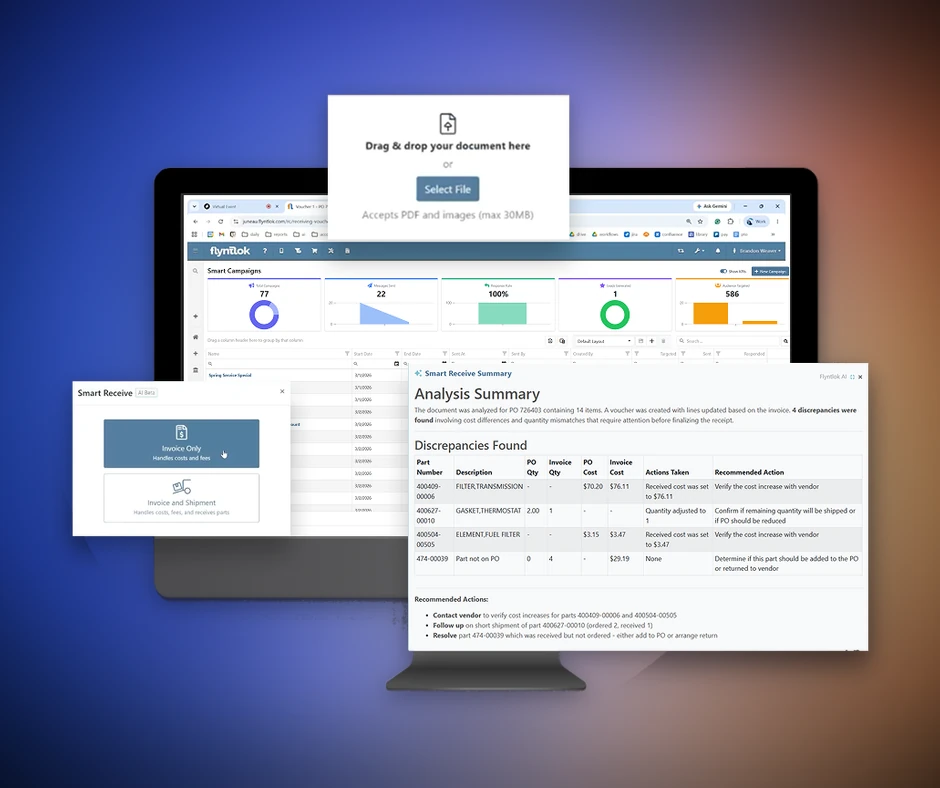
Shipments arrive during peak business hours. Your parts team stops other work to manually check invoice lines against purchase orders. AI can match invoice lines to POs, detect pricing discrepancies, flag missing or unexpected parts, and add freight fees automatically. This reduces receiving time from minutes per invoice to seconds.
According to Baker Tilly research from July 2025, dealerships using AI-powered invoice processing report reductions from 10-12 minutes per invoice down to 15 seconds. One dealership reduced invoice processing time by 50 percent, reallocating staff to more strategic functions.
Equipment dealers manage thousands of SKUs across multiple brands. AI analyzes historical sales data, seasonal patterns, and cross-location inventory to generate stocking recommendations. This helps prevent overstocking in slow months and stockouts during spring rush.
Flyntlok's demand intelligence builds on the Item Genome—a proprietary parts database covering every part for covered OEM vendors. When AI generates forecasts on this foundation, predictions account for supersession, obsolescence, and margin optimization across brands.
Clean and Fast Technician Notes
Documenting a repair is one of the most time-consuming parts of a technician's day. Technicians have to stop turning wrenches to type out what they did, and service writers then spend more time cleaning up and rewriting those notes into clear, professional language before they're fit for customers, managers, and warranty auditors. Both steps pull skilled people away from billable work.
Flyntlok’s AI-powered voice-to-text tech notes allows a technician to tap record and simply talk through the job in their own words. The system transcribes the audio, then AI is used to rewrite it into a clean, structured complaint / cause / correction story suggested directly on the job.
With AI, technicians capture their work by voice instead of typing it out, and service writers receive notes that are already clean and professional, with no rewriting required.
When a customer stops buying parts, misses a service interval, or hasn't rented in two seasons, that pattern often indicates they've moved to a competitor. AI detects these signals across your entire customer base and generates re-engagement recommendations.
Flyntlok AI identifies upcoming maintenance windows based on equipment age, hour meter data, and service history. These recommendations route directly into the CRM with SMS and email templates ready to send—so your team makes contact before the customer is lost.
AI handles routine pattern recognition well. Complex judgment, relationship management, and strategic decisions still require people.
Trade-in valuations, financing discussions, and pricing negotiations involve factors AI cannot fully evaluate—customer history, competitive positioning, relationship value, and business judgment. Your sales team brings context that no algorithm can replicate.
As noted by the Association of Finance and Insurance Professionals (AFIP) in 2026, AI systems that influence pricing or credit approvals intersect directly with regulatory requirements. The dealership remains responsible for consumer transaction decisions, even when algorithms inform those decisions.
AI can schedule service appointments and track technician productivity metrics. However, evaluating repair quality, handling customer complaints about service work, and managing technician development require human judgment. A service manager understands the difference between a metrics anomaly and a genuine performance issue.
AI generates forecasts and surfaces trends. Deciding whether to add a new product line, expand to another location, or adjust pricing strategy involves business judgment that extends beyond data patterns. Your leadership team weighs market conditions, competitive dynamics, and long-term goals that AI cannot fully model.
Not every DMS vendor offering "AI" delivers the same value. Equipment dealers should ask specific questions before relying on AI features.
AI trained on generic business data may not account for equipment dealer workflows, seasonal cycles, or multi-brand complexity. Look for systems where AI operates directly on your transaction history, parts orders, service records, and customer interactions.
AI recommendations buried in a separate dashboard often go unused. The most effective implementations surface insights inside existing workflows—your CRM, POS, and inventory management screens. If your team needs to open a different application to see AI recommendations, adoption will suffer.
Effective AI platforms are designed to augment finance professionals and operations staff, not replace them. Look for systems that automate repetitive tasks while routing exceptions and escalations to people. This balance improves speed without compromising control.
AI adoption fails when dealerships expect the technology to solve problems it wasn't designed to address.
AI handles specific tasks well. It does not eliminate operational complexity or replace trained staff. Dealerships that reduce headcount based on AI promises often find themselves scrambling when the system encounters edge cases or when customer relationships suffer from reduced personal contact.
AI learns from the data your dealership generates. If inventory counts are inaccurate, customer records are incomplete, or pricing data contains errors, AI recommendations will reflect those problems. Clean data is the foundation of useful AI output.
New AI features should run parallel to existing workflows before full adoption. Monitor AI recommendations against actual outcomes for several months. This validation period reveals accuracy patterns and helps your team build confidence in the system.
The most effective AI implementations combine automation with clear human accountability. AI handles the volume—processing thousands of invoice lines, analyzing patterns across your entire customer base, and generating stocking recommendations. Your team handles the judgment—deciding which customers warrant personal outreach, approving inventory orders, and managing exceptions.
This division creates real operational gains without sacrificing control. Your parts team spends less time on receiving paperwork and more time helping customers at the counter. Your sales team receives prioritized leads with context instead of working through a cold list. Your service advisors get proactive maintenance alerts instead of reacting to equipment failures.
For equipment dealers evaluating AI in their DMS, the question is not whether to adopt the technology. The question is where AI delivers measurable value and where human expertise remains irreplaceable.
AI assists parts staff by speeding up lookups and flagging inventory discrepancies, but it cannot replace the expertise and customer relationships your counter team brings. Flyntlok's AI features are designed to make every person more effective—surfacing opportunities and automating routine tasks so staff can focus on customers.
Intelligence analyzes prior-year sales data, current ordering trends, and cross-location inventory levels to generate seasonal stocking recommendations. Flyntlok's demand forecasting accounts for patterns that are invisible at human scale—helping you avoid overstocking in December and stockouts in April.
Complex negotiations, customer relationship management, and strategic business planning require human judgment. AI can inform these decisions with data and forecasts, but the final call belongs to your team. Regulatory compliance, trade valuations, and employee management also require human accountability.
Flyntlok AI operates on your dealership's own operational data inside the DMS. Your data stays inside Flyntlok and is never shared with other dealers, used to train models for competitors, or sold to third parties. No external data migration or separate platform is required.
The Item Genome is Flyntlok's proprietary parts intelligence engine containing every part for covered OEM vendors, organized by make, model, and application. When the intelligence layer builds predictions on this foundation—demand forecasting, supersession risk, margin optimization—results are structurally more accurate because the underlying parts data is complete.
AI features that operate on existing DMS data can surface recommendations immediately. However, predictive accuracy improves over time as the system learns from your dealership's specific patterns. Most dealers see measurable improvements in receiving efficiency and customer re-engagement within the first few months of active use.