NEW!
Meet Flyntlok at Equip Expo 2026:
September 25, 2026
The farm equipment dealer best practices that matter most are the ones that protect customer uptime across the entire dealership. That means coordinating sales commitments, service capacity, parts availability, inventory decisions, and proactive communication around one customer-critical workflow, then measuring whether the dealership delivers what it promised.
This is an operating model for the dealership, not equipment-maintenance advice. Strong parts, service, sales, and inventory practices still matter, but isolated improvements can work against each other. Sales may promise a delivery date without seeing preparation capacity. Service may schedule a repair before confirming parts. Parts may optimize stock without enough visibility into upcoming inspections or seasonal demand.
The better approach is to organize those practices around uptime and lifecycle support. Manage expectations before a customer has to chase an update. Prepare service work for a reliable first repair. Coordinate inventory with service requests and sales forecasts. Extend sales and repairs into scheduled follow-up relationships. Use technology only after ownership, handoffs, and measures are clear.
Uptime is the unifying interpretation here, not a universal industry formula. Each dealership still needs local definitions based on its customers, product lines, branches, geography, and farming calendar.
Farm equipment dealers are operating under pressure that exposes weak handoffs. An analysis of the North American 2026 Dealer Business Outlook & Trends survey reported that more than 66% of dealers said 2025 new-equipment revenue was lower than in 2024, while 55% reported lower used-equipment revenue. The same analysis said a net 42% considered new-equipment inventory too high and 27% considered used-equipment inventory too high. These figures describe the survey respondents, not every dealership, but they show why inventory and execution deserve owner-level attention (Upstream Ag).
Under those conditions, departmental optimization is not enough. A sales team can increase activity while adding poorly timed trades. A parts department can reduce stock while lowering service readiness. A service manager can load the schedule to apparent capacity while jobs wait for diagnosis, authorization, tools, or components. Each department may report progress even as customers experience delays and the dealership carries more operational risk.
Staffing adds another constraint. Purdue University’s 2025 Precision Agriculture Dealership Survey found that difficulty finding employees who can deliver precision-agriculture services was the most agreed-upon barrier to expanding those services. The survey also indicates that employee expertise remains important. That finding applies specifically to precision-ag services, but the management lesson is useful: buying technology does not create the people, knowledge, or operating discipline required to deliver the service.
Inventory pressure and constrained expertise make disconnected processes more expensive. When information remains inside departmental systems, spreadsheets, inboxes, or individual employees’ heads, leaders cannot see the complete customer commitment. They see a work order, a backordered part, a trade, or a sales forecast, but not always how those items affect the same customer’s operating window.
The response is not to make every department chase one generic target. Parts availability, service quality, equipment aging, and customer communication need different measures. The response is to connect those measures to the same operating result: whether the dealership can make a realistic commitment, execute it, and keep the customer informed.
That shifts management from a collection of departmental scorecards to coordinated farm dealership operations. Department managers retain responsibility for their work, but leadership decides which cross-functional workflow matters most, who owns its handoffs, and how performance will be judged from the customer’s side.
An uptime operating rhythm starts with the customer event that crosses departments. It might be a machine-down call, a preseason inspection, a trade awaiting reconditioning, or a sold unit that requires setup and delivery. Leadership maps that event from the first promise through completion and follow-up, including every transfer among sales, parts, service, and inventory.
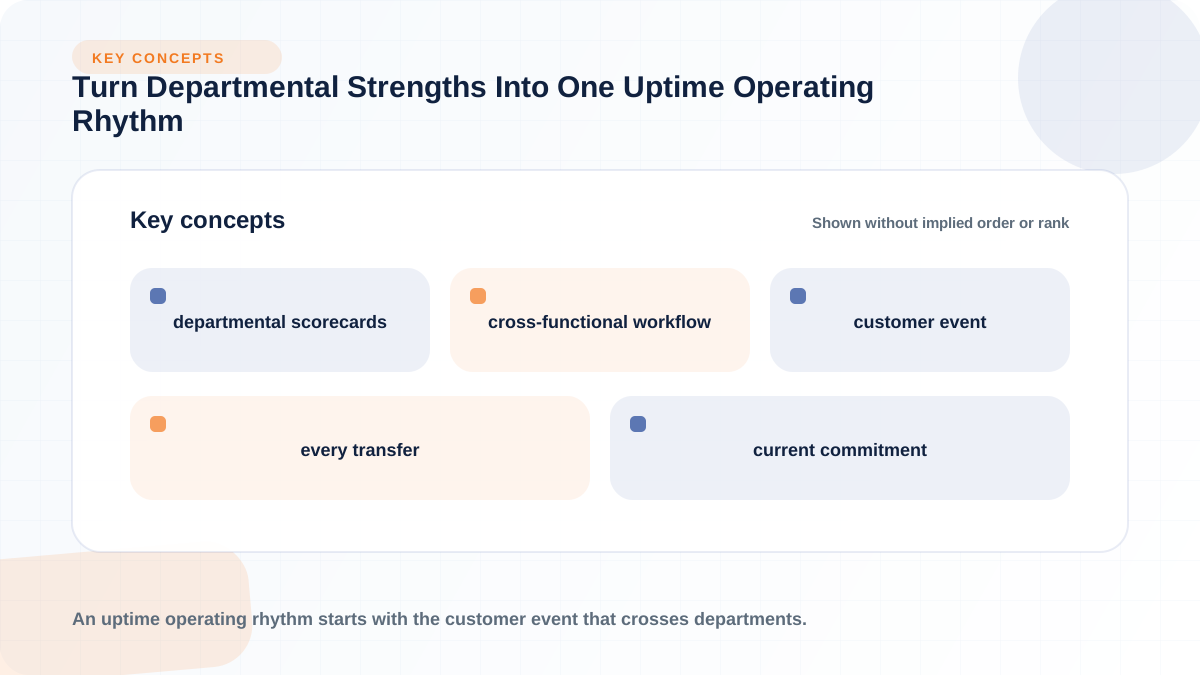
The practical test is simple: can every responsible person see the current commitment, the next action, the blocker, and the owner? If not, the dealership has separate tasks rather than one managed workflow.
Four practices create that rhythm. Commitments must reflect real capacity. Service jobs must be prepared before technician time is consumed. Inventory decisions must consider demand and service readiness together. Follow-up must turn completed transactions into continuing support. Coordinating these practices can connect proactive service and parts availability to customer value while creating more opportunities for recurring parts and service relationships.
Responsiveness means giving the customer a commitment the dealership can keep, then communicating before the customer has to request an update. Equipment-dealer guidance consistently emphasizes expectation management and proactive contact at each customer touchpoint (Winsby). The promise itself, however, has to reflect actual operating conditions.
Before committing to a completion or delivery date, the responsible employee needs visibility into technician capacity, job complexity, parts status, required tools, authorization, transport, and safe work sequencing. “Yes” without those checks merely moves conflict downstream. The customer hears a date, while parts and service inherit a commitment they may be unable to meet.
A better workflow separates fast acknowledgment from confirmed scheduling. The dealership can acknowledge the request promptly, gather the facts, identify the responsible manager, and then provide a realistic commitment. If conditions change, the update should explain what changed, what happens next, who owns it, and when the customer will hear from the dealership again.
Communication channels can help, but channel choice is secondary to ownership. Equipment World’s service guidance discusses multiple communication channels and automation. A text or portal notification is useful only when it carries accurate information from the workflow. Automating vague or outdated updates gives the customer faster access to the same uncertainty.
Acceptable timing and communication also vary. A planting-season machine-down event is not the same as a winter inspection, and a fleet account may want a different update path from an owner-operator. Ask customers directly which events require immediate contact, who should receive updates, and which milestones matter. Record those preferences so the process does not depend on one advisor remembering them.
Track status calls from customers who already placed an order or opened a service job. Rising call volume can indicate that promised updates are late, unclear, or missing. Treat it as a diagnostic signal, then trace the calls back to the handoff or status that failed.
A reliable first repair begins before the technician starts work. The service manager needs to match the job to the appropriate skill level, confirm the likely parts and specialized tools, and make relevant machine and customer information available. Equipment World identifies technician-to-work matching, parts and tool preparation, first-time-fix analysis, and schedule adherence as service best practices for equipment dealers.
That guidance is broader than farm equipment, so it should be applied as an operating principle rather than as proof of a specific farm-dealer result. The principle fits: scarce technician time should be spent diagnosing and repairing equipment, not discovering that the machine, authorization, part, tool, or service history is unavailable.
Preparation starts at intake. The work order should capture the reported symptom, operating context, machine identification, location, urgency, authorization status, and the customer’s required timing. An inspection can establish condition and provide a documented basis for additional work. When the diagnosis changes the scope, the approval and revised commitment should flow back to the customer before work continues.
First-time fix rate is the share of jobs resolved on the first repair attempt under the dealership’s documented definition. The definition matters. A dealership must decide whether the measure is based on work orders, repair events, customer complaints, or return visits, and define the period in which a repeat issue counts.
The metric becomes useful when managers analyze why work was not completed correctly the first time. Causes may include an incomplete intake, diagnosis error, missing part, unavailable tool, incorrect skill match, incomplete technical information, or a quality-control miss. Group failures by cause, job type, and technician only when the comparison is fair and the goal is process correction rather than blame.
Schedule adherence adds a different view. It compares planned work with work completed as scheduled under a consistent local definition. Used with first-time fix, it distinguishes a capacity problem from a quality problem. A shop can hit dates by rushing work, or produce good repairs while repeatedly missing commitments. Farm equipment service department best practices need both views.
Inventory management must balance availability with the cost and risk of carrying stock. The 2026 dealer outlook analysis reported concerns about both new and used equipment inventory among surveyed dealers, while farm-equipment guidance connects inventory turnover to balance-sheet management (Upstream Ag; Farm Equipment).
A single stock-level number cannot manage that tradeoff. Parts managers need to connect parts availability with active service requests, likely seasonal demand, equipment population, sales forecasts, and supplier timing. Equipment managers need visibility into aging, sales activity, trade exposure, and preparation requirements. Service and sales therefore have to contribute information rather than treating inventory as the parts or wholegoods manager’s isolated problem.
Inventory breadth and fill rate answer different questions. Rural Lifestyle Dealer describes inventory breadth as a measure taken before the customer needs the part and fill rate as a measure taken after the customer buys. In practical terms, breadth is a leading signal of whether the dealership stocks the range of items its demand pattern requires. Fill rate is the resulting share of demand fulfilled according to the dealership’s documented timing and availability rules.
High breadth does not automatically mean healthy inventory. A dealership can carry many SKUs but still miss the parts that matter, or stock too much slow-moving inventory. Fill rate can also conceal problems if the definition changes between counter demand, shop demand, emergency orders, and backorders. Define both measures by location, demand type, time window, and treatment of special orders.
Inventory turn shows how often inventory moves over a defined period, typically using cost of goods sold and average inventory at cost. Days in inventory expresses aging in time rather than turns. These measures help identify capital tied up in slow-moving parts or equipment, but they should be read beside availability measures. Raising turns by cutting critical stock can weaken service readiness.
The operating decision is therefore not “more inventory” or “less inventory.” It is the right availability for the dealership’s demand, service commitments, branches, and season, with explicit ownership of aged stock and recurring stockouts.
The customer relationship should continue after delivery or repair. Schedule the next useful event while the current interaction is still active: an inspection, planned maintenance conversation, service follow-up, parts review, or another agreed checkpoint. Equipment-dealer guidance recommends scheduling the next service or inspection after service completion, and agriculture-dealership guidance identifies inspections, service agreements, and warranties as ways to maintain continuing relationships (Winsby; OffDeal).
The aim is not contact for its own sake. Each follow-up should connect to the customer’s equipment, timing, or operating risk. Sales can capture intended use and critical periods. Service can record inspection findings and recurring repair patterns. Parts can identify upcoming needs tied to planned work. Together, those facts support a more relevant conversation than a generic reminder.
A proactive service model changes the dealership’s work. Equipment World frames the customer value as avoiding downtime and discusses using data to move from reactive repair toward predictive or preemptive service. For a dealership, that shift requires usable equipment history, defined triggers, staff who can interpret the information, customer authorization, and capacity to act.
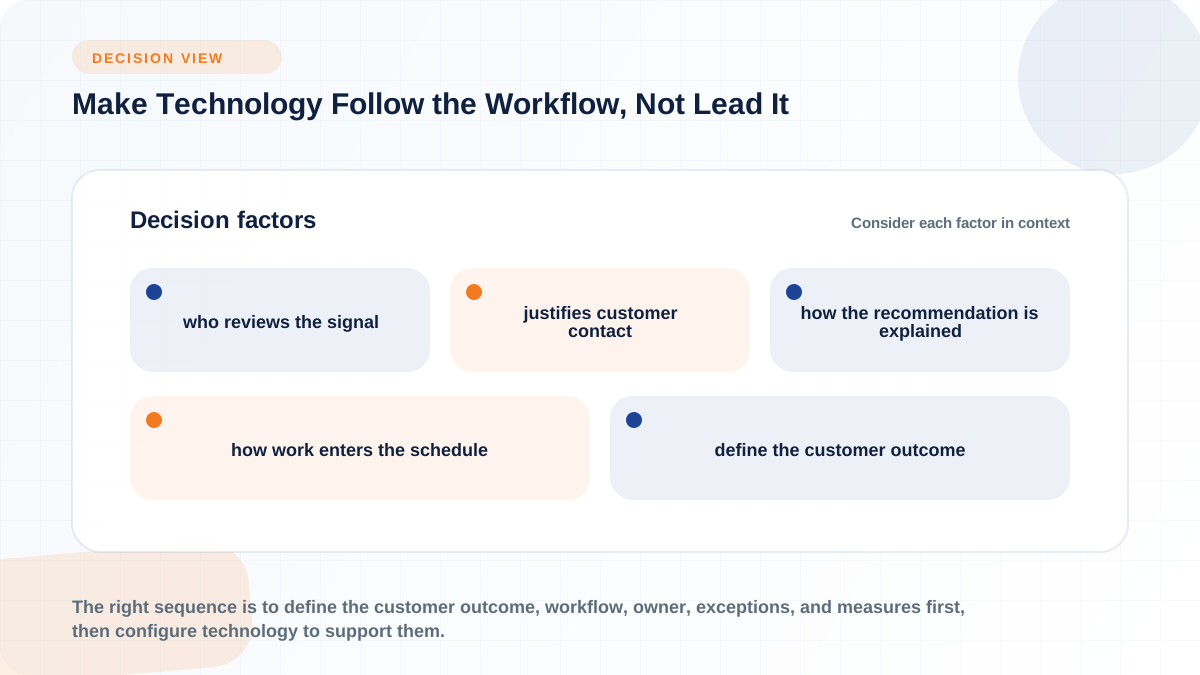
It also requires restraint. An automated alert is not a diagnosis, and a predicted need is not a completed repair. The dealership must decide who reviews the signal, whether it justifies customer contact, how the recommendation is explained, and how work enters the schedule.
Service agreements or warranties may support a recurring relationship where they fit the customer and offering. Their operational value depends on delivery: inspections completed, commitments tracked, parts prepared, and follow-up performed. The stronger lifecycle relationship comes from reliable execution over time, not from the agreement alone.
Technology can improve visibility, automate communication, and support better decisions, but it is not the main route to dealership improvement by itself. The right sequence is to define the customer outcome, workflow, owner, exceptions, and measures first, then configure technology to support them.
The technology-first case is understandable. Connected data can reduce duplicate entry, show departments the same current job status, and make customer communication easier. Service guidance describes the use of data to identify patterns and move toward proactive work, while dealer-management commentary argues that digital transformation involves redesigning work rather than inserting new technology into existing processes (Equipment World).
AI adds useful possibilities, but the current precision-ag evidence points toward augmentation rather than unattended replacement. In Purdue University’s 2025 Precision Agriculture Dealership Survey, almost half of dealers said AI would lead to better agronomic recommendations, while few said it would reduce their need for agronomic expertise or lower operating costs. The survey also found that finding employees able to deliver precision-ag services remained the leading barrier to expansion.
That balance matters. A tool may draft a status update, surface an overdue task, classify a request, or help a manager review dealership data. It does not decide what the dealership should promise, whether the information is correct, or who takes responsibility for an exception. Those are management decisions.
Start with one broken customer-critical workflow. Define its trigger, steps, responsible roles, required data, escalation path, and completion condition. Then evaluate whether the current systems can make the work visible and enforce the handoffs. Dealer workflow automation is useful when it shortens a known delay or prevents a known miss. If nobody owns the underlying process, automation usually makes ambiguity move faster.
Standardize the points where responsibility changes hands before automating the workflow. Agriculture-dealership guidance recommends standard operating procedures for customer intake, financing, service-order management, and equipment inspections, along with inventory systems that connect parts availability, service requests, and sales forecasts (OffDeal).
A usable procedure should state what starts the work, what information is required, who owns the next action, which exceptions require escalation, and what counts as complete. For a service intake, that might include machine identification, symptoms, location, authorization, timing, assigned advisor, initial parts check, and the next promised customer update. For a sold unit, it might connect sales approval, preparation, accessory installation, documentation, and delivery scheduling.
Documentation also preserves operating knowledge. When diagnostic steps, inspection standards, customer preferences, and exception decisions exist only in an experienced employee’s memory, absence or turnover can stall the workflow. Capturing that knowledge does not replace judgment. It gives the next employee a reliable starting point and makes gaps visible to the manager.
Multi-branch groups need common definitions for shared reporting, but not every branch needs identical staffing or routing. Standardize the required data, status names, ownership rules, and completion criteria. Allow local variation where product mix, distance, customer type, or season changes how the work must be executed.
Automation comes last. Once the handoff is clear, the system can route a task, require a field, notify the next owner, or trigger an update. The technology should reinforce accountability already chosen by leadership.
Automation and AI need operating guardrails before dealership data is used to generate recommendations, messages, or actions. The continuing importance of employee expertise in the 2025 Precision Agriculture Dealership Survey makes human responsibility central, especially where a recommendation could affect a customer commitment or service decision.
Before approving a use case, dealership leadership should answer five questions:
These are leadership questions, not a substitute for technical or legal review. They force the dealership to name the accountable person instead of treating the tool as the decision-maker.
Begin with a bounded use case where employees can verify the output and correct errors before harm spreads. Record what the tool is allowed to do, what it cannot do, and how exceptions are escalated. If the team cannot explain those limits in operational language, the use case is not ready for automation.
Choose the first change by finding the customer-facing symptom that crosses departments, then assign one accountable owner and pair an early warning signal with an outcome measure. Do not begin with the easiest software feature or the loudest departmental complaint. Begin where a failed handoff most directly affects a commitment to the customer.
A leadership scorecard should combine leading and outcome measures. A leading signal gives management a chance to act before the customer experiences the full failure. An outcome measure shows what happened after the workflow ran. The matrix below provides a starting structure, not universal farm equipment dealership KPI targets.
Define every measure before using it. Inventory breadth gauges whether the dealership carries the range of parts included in its defined demand set before a request occurs. Fill rate records the share of demand fulfilled under the chosen timing and availability rules after the request. That leading-versus-outcome distinction follows the explanation published by Rural Lifestyle Dealer.
First-time fix rate measures jobs resolved on the first repair attempt according to a written rule. Schedule adherence compares scheduled work with work completed as planned. Status-call volume counts customer inquiries about existing orders or jobs and can expose missing proactive updates. These measures appear in equipment-dealer service guidance, which also recommends analyzing the reasons behind repeat repairs rather than stopping at the top-line rate (Equipment World; Winsby).
Inventory turn compares the cost of goods sold over a defined period with average inventory at cost. Days in inventory expresses how long stock remains on hand under the dealership’s chosen formula. Absorption rate compares defined parts, service, and other fixed-operations contribution with defined fixed operating expenses. Keep the formula, included accounts, period, and branch treatment consistent before comparing results.
Set local baselines instead of borrowing a universal target. Product mix, branch structure, geography, OEM relationship, customer mix, and farming cycle can all change what a useful comparison looks like. Compare like periods, including the same seasonal window, and segment only where the sample remains meaningful. A preseason month should not be judged against an off-season month without context.
For a single-location dealership, one leader may own the complete cross-functional workflow even though department managers own individual steps. Start with one visible board or report and review exceptions at a fixed cadence. The goal is not more reporting. It is faster resolution of blockers.
For a multi-branch group, use common definitions and compare branches only after confirming that they record events the same way. Name both a group-level process owner and a branch-level owner. Review outliers to find differences in workflow, demand, staffing, or data quality before treating the ranking as performance.
The first improvement cycle is straightforward: establish the baseline, select one symptom, map the handoffs, assign the owner, choose one leading and one outcome measure, run the change through a comparable period, and review the exceptions. Keep the change narrow enough that managers can identify what actually improved or failed.
Once those operating requirements are clear, a connected system can support them. Flyntlok is a cloud-based dealer management system for agriculture, heavy equipment, outdoor power equipment, and commercial vehicle dealerships. If your current tools cannot connect customer commitments, parts availability, work orders, and accountable handoffs, see Flyntlok in action and evaluate it against the workflow and scorecard your dealership has already defined.